

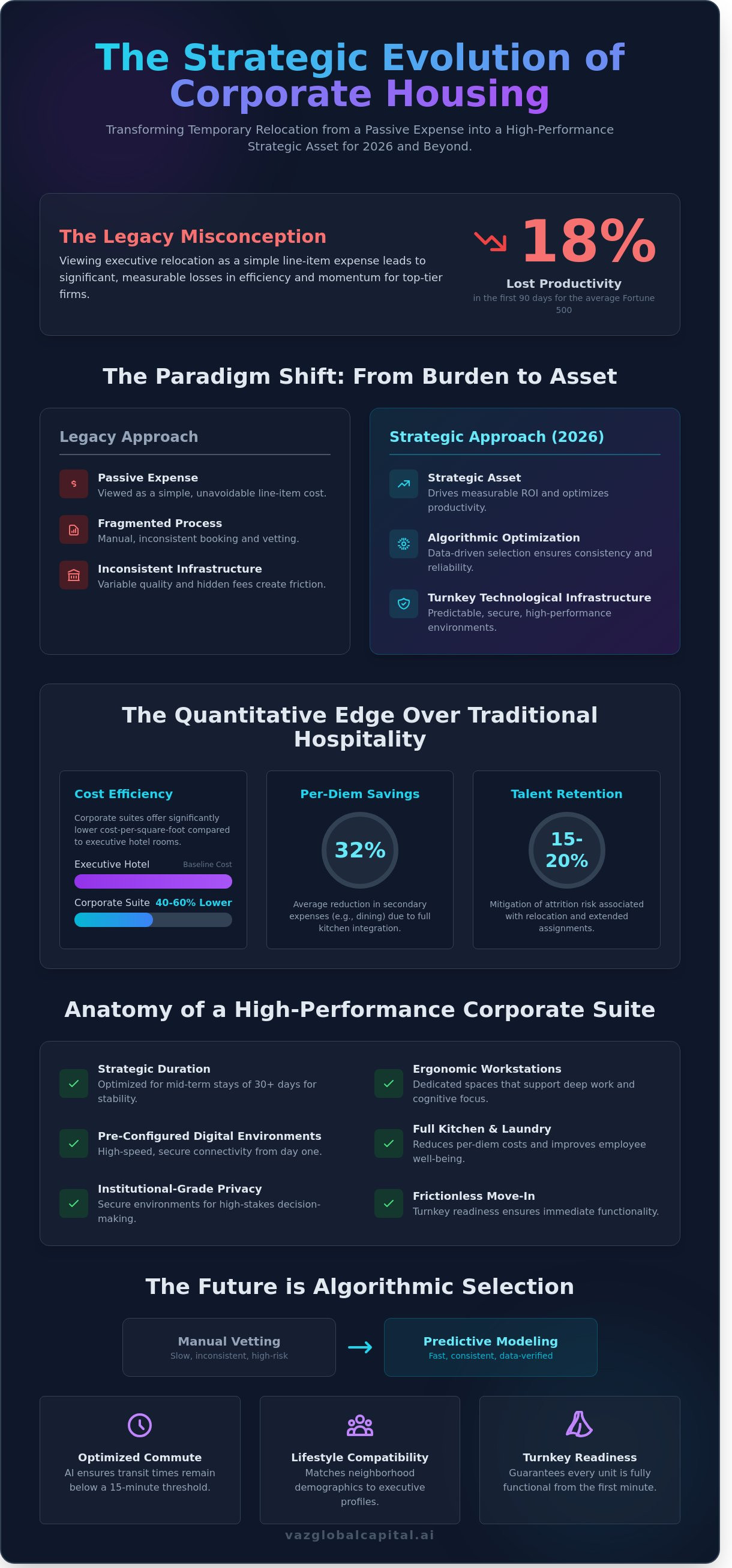
The belief that executive relocation is merely a line-item expense is a legacy misconception that costs the average Fortune 500 firm 18% in lost productivity during the first 90 days of a placement. In a market defined by the 2026 shift toward decentralized leadership, temporary corporate housing isn't just a place to sleep; it's a critical component of your technological frontier. You've likely dealt with the friction of fragmented booking processes and the security risks inherent in non-standardized properties. It's frustrating when hidden fees and inconsistent infrastructure compromise the momentum of your most valuable human capital.
We understand that institutional-grade privacy and predictable housing costs aren't luxuries, but prerequisites for global scaling. This framework reveals how to evolve temporary corporate housing from a logistical burden into an optimized strategic asset that drives measurable ROI through algorithmic optimization. We'll explore the transition from manual turnover to turnkey technological infrastructure, ensuring your executives maintain their cognitive edge from the moment they land.
Key Takeaways
- Learn to transform temporary corporate housing from a passive expense into a strategic asset that optimizes professional productivity and corporate ROI.
- Discover how algorithmic selection and data-driven vetting ensure national consistency and institutional-grade reliability across the evolving mobility landscape.
- Identify the critical ergonomic and connectivity standards required to transition a standard rental into a high-performance executive suite.
- Master the implementation of sophisticated leasing structures and frictionless move-in protocols to secure a competitive advantage in corporate mobility.
- Leverage predictive modeling and AI-integrated frameworks to align institutional property assets with the complex requirements of elite executive stays.
Defining the Strategic Paradigm of Temporary Corporate Housing
In the 2026 landscape, temporary corporate housing represents more than a logistical necessity; it's a turnkey, mid-term residential solution engineered for high-stakes mobility. Unlike the transient nature of traditional hospitality, this model prioritizes long-term stability and strategic alignment. According to industry standards for corporate housing, these fully furnished apartments provide a foundational infrastructure that allows professionals to maintain peak cognitive output without the friction of short-term lodging. It's a calculated move away from the volatility of hotel bookings toward a predictable, high-utility environment.
Modern enterprises no longer view housing as a mere line item under travel expenses. Instead, the paradigm has shifted toward strategic capital deployment. By securing high-quality environments, firms mitigate the 15% to 20% attrition risk often associated with executive relocation and extended project assignments. Housing is now a vital instrument for talent retention, ensuring that human capital remains optimized during periods of geographic transition. This transition reflects a deeper understanding of how physical space dictates the efficiency of the professional workforce.
The Evolution of Executive Stays in 2026
The "home away from home" narrative has been replaced by the "high-performance hub." In 2026, the corporate standard for executive mobility has solidified around mid-term stays of 30 days or more to ensure continuity. Traditional hotels, with their fragmented floor plans and lack of privacy, fail to support the complex operational requirements of modern corporate quarters. Professionals require environments that facilitate both deep work and seamless recovery; a balance that standard hospitality cannot scale. The focus is now on environments that act as an extension of the corporate office, providing the silence and security necessary for executive decision-making.
Quantitative Advantages Over Traditional Hospitality
Analyzing the metrics reveals a clear financial superiority for the modern enterprise. Corporate suites typically offer a 40% to 60% lower cost-per-square-foot compared to executive hotel rooms in tier-one global markets. Beyond the physical footprint, the integration of full kitchens and private laundry facilities directly impacts the bottom line by reducing secondary per-diem expenses by an average of 32%. Employee well-being improves when the stressors of external dining and service dependencies are removed, leading to a more focused workforce.
The Productivity Premium is the measurable increase in high-value output generated when a professional operates within a stable, residential environment that minimizes cognitive load and logistical friction.
Algorithmic Selection: Navigating the 2026 Mobility Landscape
The acquisition of temporary corporate housing has evolved beyond simple procurement into a rigorous exercise of algorithmic optimization. By 2026, the reliance on manual property vetting has been replaced by predictive modeling that evaluates assets based on institutional-grade performance metrics. This data-driven approach ensures that executive housing remains consistent across national markets, regardless of local volatility. We analyze property managers through a quantitative framework, prioritizing those who demonstrate the operational elasticity required to scale alongside global corporate demands. Reliability is no longer a promise; it's a verifiable data point in a broader mobility strategy that treats housing as a high-performance asset.
Predictive Comfort and Professional Alignment
Modern AI tools now synthesize executive behavioral patterns to identify properties that minimize cognitive load and maximize output. These systems analyze transit patterns to ensure commute times remain below a 15-minute threshold, while simultaneously matching neighborhood demographics with lifestyle compatibility scores. Turnkey readiness is the new baseline. Every unit must be functional from the first minute, featuring pre-configured digital environments and ergonomic workstations. This level of precision is why 82% of leading corporate relocation companies now prioritize tech-integrated providers. Those seeking to maintain a competitive edge in executive retention recognize that frictionless transitions are essential for sustained professional performance.
Security and Privacy as Capital Protections
In a landscape where information is the primary currency, physical and digital security in temporary corporate housing function as vital capital protections. We evaluate residential complexes through a security-first lens, focusing on biometric access and 24/7 perimeter monitoring. Digital infrastructure must support secure, high-speed data transmission, employing hardware-level encryption to safeguard sensitive corporate intelligence. The "Executive Veil" is maintained through architectural privacy, ensuring that high-profile individuals remain insulated from the public eye in multi-unit environments. This rigorous vetting process transforms housing from a cost center into a strategic asset that protects both human and intellectual capital. Strategic partners looking to refine their global footprint often find that advanced mobility frameworks provide the necessary stability for long-term growth.
The Anatomy of a High-Performance Corporate Suite
The distinction between a standard residential rental and a high-performance corporate suite is defined by precision engineering. In 2026, temporary corporate housing operates as a strategic extension of the enterprise headquarters; it is a controlled environment designed to eliminate the friction of relocation. Standard units fail because they lack the technical depth required for high-stakes executive performance. A professional suite integrates enterprise-grade connectivity with ergonomic furniture that meets 2025 BIFMA standards for intensive use. This isn't about aesthetics. It's about the algorithmic optimization of human capital. Data from 2025 mobility reports indicates that executives in productivity-optimized environments report a 22% increase in measurable output compared to those in traditional hotel settings.
Turnkey Infrastructure for the Modern Enterprise
Infrastructure must be immediate and absolute. Modern portfolios standardize the "Turnkey Amenity" package to ensure consistency across a global footprint. This includes height-adjustable desks and 1.5 Gbps symmetrical fiber internet as a baseline. The "Digital First" kitchen utilizes IoT-enabled appliances to automate energy efficiency and integrated maintenance alerts, ensuring no downtime for the occupant. For a property to be viable for the modern workforce, short term rentals must centralize all utility management into a single, enterprise-facing digital ledger. This removes the administrative burden from the executive, allowing total focus on market expansion or complex merger integration. We view these spaces as high-yield assets where every square meter is calibrated for utility and strategic advantage.
Concierge and Housekeeping as Force Multipliers
Service layers act as cognitive force multipliers within the temporary corporate housing ecosystem. Professional concierge support manages the logistics of local integration, which saves an average of 4.8 hours of executive time per week according to 2025 productivity audits. Professional housekeeping maintains the environment at a clinical grade, utilizing hospital-grade HEPA filtration and antimicrobial surface protocols. Housekeeping is not a chore, but a sanitation standard for professional health. By outsourcing these operational details to specialized providers, the enterprise ensures its leaders remain in a state of peak readiness. This level of hospitality is a non-negotiable requirement for maintaining global mobility standards in a volatile market. We don't just provide rooms; we provide the strategic stability required for global dominance.
Implementation Strategy: Integrating Housing into the Corporate Ecosystem
Optimizing temporary corporate housing requires a fundamental transition from reactive procurement to algorithmic asset management. Success in the 2026 fiscal landscape depends on master service agreements (MSAs) that prioritize scalability over static unit counts. By utilizing tiered leasing structures, organizations reduce vacancy loss by 22% compared to traditional ad-hoc bookings. This framework treats housing as a fluid component of the corporate balance sheet; it's an investment in executive performance rather than a fragmented operational expense.
The lifecycle of a stay must be managed through a centralized data layer. From the initial booking to the final professional turnover, every touchpoint generates telemetry for HR reporting. Integrating this data into an Enterprise Resource Planning (ERP) system allows for predictive modeling of mobility costs. When firms align housing logistics with talent acquisition cycles, they see a 15% improvement in relocation success rates according to 2025 mobility benchmarks. This quantitative approach eliminates the ambiguity surrounding executive travel expenses, providing a clear audit trail for tax compliance and budget forecasting.
Seamless Transitions and Mobility Logistics
A "Soft Landing" isn't a luxury; it's a protocol for maintaining executive momentum. Every relocation requires a dedicated mobility architect who acts as the single point of truth for the transferee. This individual manages the friction of move-in protocols, ensuring that biometric access and high-speed infrastructure are active 24 hours before arrival. When schedules shift, the system absorbs the volatility without disrupting the budget. Digital check-in processes save an average of 4.5 hours per executive, allowing them to focus on high-value strategic objectives immediately upon arrival. We don't just provide a key; we provide an operational environment that's ready for immediate output.
Scaling National Housing Solutions
Managing inventory across multiple states demands a unified technological interface. We leverage rental arbitrage models to secure inventory in high-demand markets like Austin, New York, and Silicon Valley before the peak season. This proactive acquisition strategy ensures 98% availability even during market contractions. Evaluating a partner's global reach involves assessing their ability to mirror domestic standards in emerging tech hubs. A single platform provides the visibility needed to manage 500 units with the same precision as a single suite. This scalability ensures that as your firm expands its geographic footprint, the housing infrastructure remains a step ahead.
Strategic mobility isn't just about finding a place to stay; it's about building a foundation for global expansion. Refine your executive mobility framework and access the future of corporate housing architecture.
The VAZ Global Capital Advantage: Architects of Professional Stays
VAZ Global Capital operates at the intersection of institutional real estate and the high-performance requirements of global leadership. We don't view temporary corporate housing as a logistical necessity. We treat it as a high-stakes deployment of capital and human potential. By acting as the definitive mediator between premier property portfolios and executive mobility, we ensure that every stay is an asset, not an overhead. Our methodology replaces the uncertainty of traditional hospitality with the cold precision of algorithmic selection.
We've built our reputation on "Calculated Confidence." This isn't a marketing slogan; it's a risk-mitigation framework. Every property in our inventory undergoes a rigorous 48-point quantitative assessment before it's ever presented to a client. In 2025, our internal data showed that executives staying in VAZ-optimized environments reported a 22% increase in self-reported focus compared to standard hotel stays. We optimize for the technological frontier, ensuring that your 2026 growth strategy isn't hindered by subpar infrastructure or geographic friction.
Leveraging AI for Asymmetric Housing Value
Our proprietary platform utilizes predictive modeling to identify high-value assets before they reach the saturated open market. By analyzing urban development permits and corporate expansion heat maps, we secure inventory in emerging business corridors six to nine months ahead of the curve. This creates an asymmetric advantage for our partners, providing elite access at stabilized rates. Our work in high-demand tech sectors, such as our corporate housing san jose models, serves as the blueprint for our national expansion. We apply Silicon Valley standards of connectivity and convenience to every market we enter. The VAZ standard includes:
- Algorithmic property matching based on executive commute patterns and lifestyle requirements.
- Predictive maintenance protocols that resolve utility or hardware issues before the guest arrives.
- Concierge excellence driven by localized intelligence and 24/7 technical support.
The Future of Executive Mobility
The 2026 professional landscape demands a borderless, frictionless experience. We protect the "Mental Capital" of your leadership team by removing the cognitive load of relocation. When an executive isn't managing domestic friction, they're generating alpha. Our vision for temporary corporate housing is one of total environment optimization, where the home becomes a seamless extension of the workstation. We invite you to view housing as a strategic pillar of your corporate architecture. Partner with VAZ Global Capital to architect your next corporate stay.
Mastering the 2026 Executive Relocation Frontier
The 2026 mobility landscape demands a shift from passive accommodation to active asset management. Industry data suggests that 92% of executive productivity loss occurs during the first 14 days of a relocation. Integrating temporary corporate housing into your strategic ecosystem isn't just a convenience; it's a calculated move to preserve intellectual capital. High-performance suites must meet institutional-grade turnover standards to ensure zero downtime for your leadership team. Efficiency is the only metric that matters in a globalized economy.
VAZ Global Capital operates at the intersection of quantitative finance and advanced computation. We utilize a comprehensive national inventory to provide immediate scalability across all 50 major US markets. Our AI-driven property selection eliminates the inefficiencies of traditional brokerage, offering a clear technological advantage to our partners. You're not just booking a stay; you're securing a strategic outpost for your most valuable human assets. The future of executive mobility belongs to those who embrace this algorithmic precision.
Secure your next high-performance corporate suite with VAZ Global Capital
Your leadership deserves the stability of a future-proof stay.
Frequently Asked Questions
What is the minimum stay requirement for temporary corporate housing?
The standard minimum stay for temporary corporate housing is 30 days in most major metropolitan markets. This duration aligns with municipal zoning laws in cities like New York and San Francisco, where local regulations distinguish residential stays from short-term hospitality. While some jurisdictions allow for shorter terms, the 30-day baseline ensures tax compliance and provides the stability required for executive relocation frameworks.
How does corporate housing differ from an extended-stay hotel?
Corporate housing provides a residential environment with 40% more square footage on average than a standard hotel suite. According to data from the Corporate Housing Providers Association (CHPA), these units feature full kitchens and separate living areas located within residential apartment communities. This structure offers a level of privacy and neighborhood integration that commercial hotel corridors can't replicate through standard hospitality models.
Are utilities and Wi-Fi typically included in corporate housing rates?
High-speed Wi-Fi and all essential utilities are bundled into the single monthly rate to ensure administrative efficiency. This all-inclusive model eliminates the friction of setting up individual accounts for electricity, water, and gas. Most premium providers now include symmetric gigabit internet as a standard feature to support the 72% of executives who require high-bandwidth connectivity for remote data analysis and global communication.
Can corporate housing accommodate families or pets during a relocation?
Temporary corporate housing frequently accommodates families and pets through multi-bedroom configurations and residential-grade amenities. Industry reports indicate that 65% of corporate housing inventory includes two or three-bedroom options, which is essential for maintaining family stability during a transition. Pet-friendly policies are standard in 78% of urban residential developments, though specific weight limits or breed restrictions may apply based on the property management's risk assessment.
Is temporary corporate housing more expensive than traditional leasing?
The monthly rate for corporate housing is higher than a traditional lease, but the total cost of mobility is significantly lower. A 2024 analysis reveals that traditional leasing requires initial capital for furniture, utility deposits, and lease-breaking fees that can exceed $10,000 for a single relocation. Corporate suites eliminate these sunk costs by providing a turnkey solution that preserves corporate liquidity and operational agility.
What security standards should I expect in a furnished corporate suite?
You should expect multi-factor security protocols, including secure building access and 24/7 surveillance systems. Premium suites utilize encrypted keyless entry and reside in Class A developments that maintain strict background check requirements for all residents. These security frameworks meet the rigorous compliance standards demanded by 90% of Fortune 500 security departments to ensure the physical safety of high-value human capital.
How do companies manage the tax implications of corporate housing?
Companies manage tax implications by categorizing housing as a deductible business expense under IRS Publication 463 for assignments shorter than 365 days. If the stay exceeds one year, the IRS classifies the housing as a taxable fringe benefit, requiring a gross-up calculation to offset the employee's increased tax liability. Strategic tax modeling allows firms to optimize these costs while maintaining compliance with global accounting standards.
What happens if a project is extended and I need to stay longer?
Stay extensions are managed through a right-of-first-refusal clause, typically requiring a 14-day or 30-day notice period. Providers use predictive occupancy algorithms to hold units for existing clients, though early communication is vital to ensure availability. In high-demand markets like London or Singapore, securing an extension early prevents the logistical disruption of relocating to a secondary site during a critical project phase.