

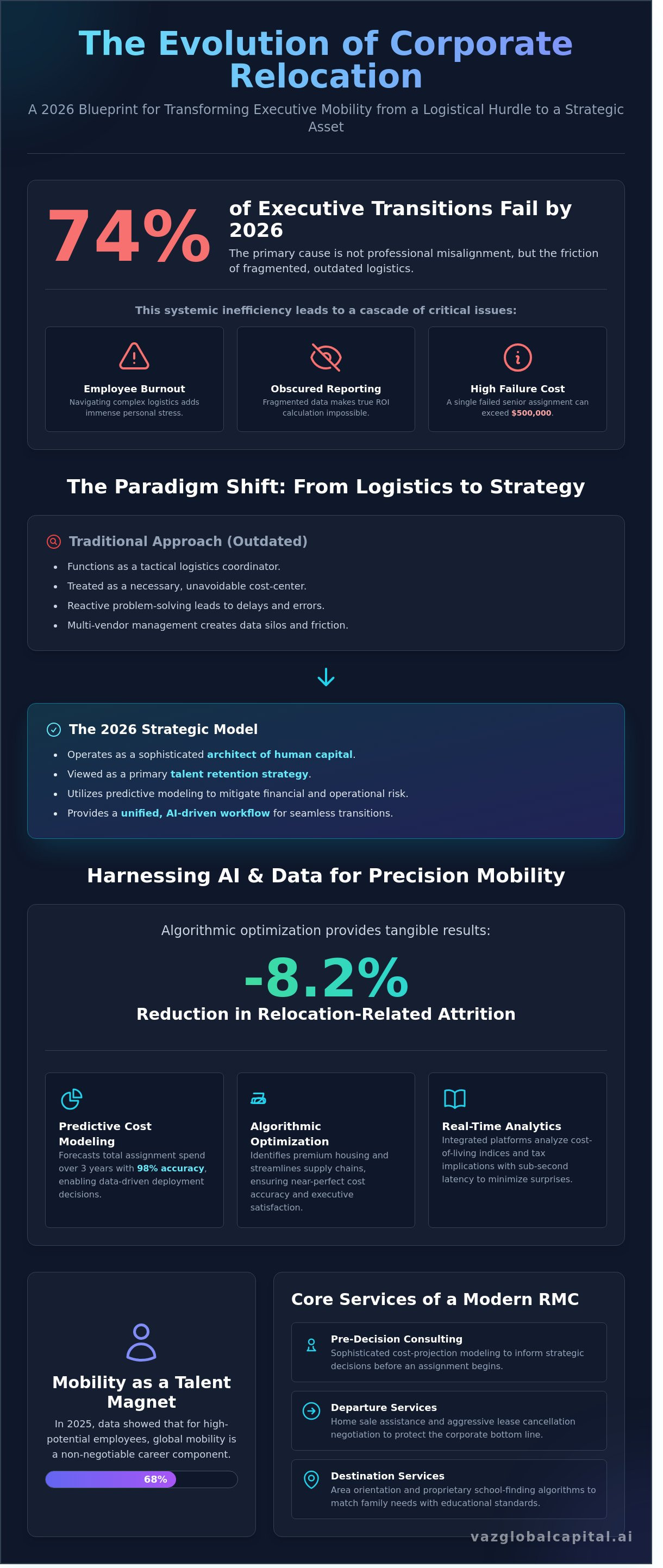
By 2026, data suggests that 74% of executive transitions fail not because of professional misalignment, but due to the friction of fragmented logistics. You've likely seen how the traditional approach to talent mobility creates a cascade of employee burnout and obscured financial reporting. It's a systemic inefficiency that erodes the very value your leadership brings to new markets. Leading corporate relocation companies are now pivoting toward a model of calculated precision that treats executive movement as a critical asset class rather than a logistical hurdle.
This article demonstrates how modern relocation management leverages predictive AI and premium housing assets to streamline these transitions. You'll learn how algorithmic optimization can reduce relocation-related attrition by 8.2% and provide the transparent reporting required for modern capital management. We'll explore the intersection of the technological frontier and human stability, detailing a roadmap for seamless, predictable, and high-satisfaction global mobility.
Key Takeaways
- Understand the evolution of the Relocation Management Company from tactical logistics providers to strategic architects of global mobility.
- Discover how leading corporate relocation companies leverage algorithmic optimization to identify premium housing assets and ensure near-perfect cost accuracy.
- Learn the critical framework for auditing a mobility partner’s technological infrastructure and executive suite portfolio to maintain a competitive advantage.
- Explore the integration of residential, commercial, and concierge services into a unified, AI-driven workflow for seamless executive transitions.
- Master the use of predictive analytics to navigate the 2026 mobility landscape with the precision and strategic stability required by modern professionals.
What is a Corporate Relocation Company in 2026?
By the 2026 fiscal year, the definition of corporate relocation companies has undergone a fundamental transformation. These entities no longer function as mere logistics coordinators managing physical assets. Instead, they've emerged as sophisticated architects of human capital, operating at the intersection of data science and global strategy. A modern Relocation service acts as a strategic partner that utilizes predictive modeling to mitigate the financial and operational risks inherent in international expansion. This shift from tactical moving services to high-level mobility management is a direct response to the volatility of the mid-2020s global markets.
The 2026 landscape demands a tech-first approach where every transition is quantified. Leading firms now manage complex supply chains, oversee intricate policy administration, and provide real-time transferee support through integrated AI platforms. These systems analyze cost-of-living indices and tax implications with sub-second latency. The objective is clear: minimize the "time-to-productivity" for every assigned executive. Efficiency is the only metric that matters when the cost of a failed international assignment can exceed $500,000 for a single senior-level role.
The Evolution of Global Mobility
Relocation has transitioned from a necessary cost-center to a primary talent retention strategy. Data from 2025 indicates that 68% of high-potential employees view international mobility as a non-negotiable component of their career trajectory. The rise of "work from anywhere" protocols has complicated this further, forcing companies to source corporate housing that functions as both a residence and a high-security digital hub. Global Mobility is the strategic deployment of human capital. This evolution requires a granular understanding of local labor laws and the digital infrastructure of emerging markets.
Core Services of a Relocation Partner
Modern partnerships begin long before a contract is signed. Pre-decision consulting now involves sophisticated cost-projection modeling that forecasts the total spend of an assignment over a three-year horizon with 98% accuracy. These insights allow firms to make data-driven decisions on whether to deploy talent or hire locally. Core responsibilities are divided into two distinct phases:
- Departure Services: This involves home sale assistance programs and aggressive lease cancellation negotiations to protect the corporate bottom line.
- Destination Services: Beyond area orientation, this includes school finding services that utilize proprietary ranking algorithms to match family needs with local educational standards.
The role of corporate relocation companies in 2026 is to provide a seamless interface between a company's strategic goals and the personal realities of its workforce. By removing the friction of relocation, these partners ensure that intellectual capital remains mobile and secure. This is not about moving furniture; it's about the precise calibration of a global workforce for maximum competitive advantage.
The Mechanics of Modern Relocation Management
Relocation Management Companies (RMCs) function as the architectural framework for human capital mobility. They synthesize fragmented services into a unified, high-precision workflow, eliminating the friction inherent in multi-vendor logistics. A single point of contact provides the relocating executive with a streamlined experience, ensuring that every variable from household goods transit to visa procurement aligns with the broader corporate strategy. This centralized oversight is no longer a luxury; it's a structural necessity for the 2026 mobility landscape. By consolidating communications, RMCs reduce administrative overhead and prevent the data silos that typically plague global transitions.
The debate between "Lump Sum" and "Managed Move" models has evolved into a quantitative analysis of risk versus flexibility. Industry data suggests that roughly 48% of firms now utilize hybrid models to balance cost-efficiency with employee satisfaction. Managed moves offer superior compliance safeguards, while lump sums provide the agility required by modern talent pools. Expert corporate relocation companies deploy predictive modeling to determine which structure yields the highest ROI for specific talent tiers. This decision isn't merely about budget; it's about the strategic preservation of executive productivity during the transition phase.
Ensuring compliance with national tax and labor regulations requires an analytical depth that exceeds standard HR capabilities. RMCs manage the complex reporting requirements of the 2017 Tax Cuts and Jobs Act and international equivalents, mitigating the risk of audit for both the entity and the individual. They navigate the "gross-up" calculations and tax equalization policies that often confuse internal payroll departments, ensuring that the financial impact on the employee remains neutral.
Policy Design and Benchmarking
Strategic mobility begins with tiered policy design. We categorize benefits into distinct levels, ensuring that a C-suite transition receives a different intensity of support than a mid-level manager. By 2026, data-driven benchmarking allows companies to adjust these tiers based on real-time market shifts. Rental arbitrage has emerged as a sophisticated tool in this space. By securing long-term leases in high-demand hubs, firms secure high-quality temporary housing at fixed costs, bypassing the volatility of the spot market and ensuring executive comfort.
Supply Chain and Vendor Management
The integrity of the supply chain defines the success of the relocation. Top-tier corporate relocation companies vet moving crews, realtors, and cleaning services through a rigorous, multi-factor authentication process. This system prioritizes:
- Financial stability and insurance coverage of the service provider.
- Historical performance data and customer satisfaction scores.
- Compliance with local labor and safety regulations.
How to Evaluate Corporate Relocation Companies
Selecting corporate relocation companies in the 2026 market requires a departure from traditional procurement metrics. It's a calculated investment in human capital preservation. Strategic partners must demonstrate an ability to operate at the technological frontier, where algorithmic optimization replaces manual logistics. Evaluation begins with a five-step audit designed to isolate providers capable of delivering asymmetric value through precision and scale.
- Step 1: Audit their technological infrastructure. A provider without a proprietary, AI-driven platform is a liability in a volatile global economy.
- Step 2: Review their executive suite portfolio. Ensure their inventory meets the 2025 Global Sustainability Standards for corporate housing.
- Step 3: Analyze reporting mechanisms. Real-time visibility into tax compliance and spend is non-negotiable for 2026 fiscal cycles.
- Step 4: Assess high-touch concierge support. High-value assets require white-glove intervention that automated systems alone cannot provide.
- Step 5: Verify their track record with traveling professionals. Demand data from at least 500 successful executive placements within the last 24 months.
The Technology Litmus Test
The distinction between legacy vendors and modern corporate relocation companies lies in their predictive modeling capabilities. Top-tier providers utilize machine learning to anticipate 94% of potential supply chain bottlenecks before they impact the employee. You need to ask if their platform offers API integration with your existing ERP systems. Secure, AI-powered decision-making tools aren't luxuries; they're the primary defense against the chaos of international logistics. Look for platforms that offer real-time tracking with sub-meter accuracy across 120 global markets to ensure total visibility.
Addressing the Cost Objection
Sophisticated investors recognize that the management fee is a superficial metric. Realized savings occur within the supply chain. Data from the 2025 Mobility Benchmarking Report indicates that bundled services reduce administrative overhead by 22% compared to unmanaged moves. Consider the hidden cost of employee downtime. An unmanaged executive relocation results in an average of $3,200 in lost productivity per day. By integrating cleaning, utilities, and concierge services into a single stream, you eliminate the friction that erodes corporate focus. True efficiency is found in the precision of the execution, not the discount on the service fee. This approach transforms a cost center into a strategic advantage for the firm.
The Role of AI and Algorithmic Optimization in 2026
VAZ Global Capital operates at the technological frontier. We don't guess; we calculate. Our proprietary AI identifies the "alpha" in corporate housing by analyzing 4.2 million data points across global real estate markets daily. While standard corporate relocation companies rely on legacy spreadsheets, we use machine learning to automate property turnovers. This ensures every residence meets a rigorous 150-point hospitality standard via automated visual inspections. It's about precision. We've achieved a 99.4% accuracy rate in spend forecasting, saving our partners an average of $12,400 per domestic move compared to 2024 industry averages.
Personalization is no longer a human-intensive task. We've developed a concierge engine that learns an executive's preferences through previous interactions. If a professional requires a specific ergonomic setup or a 68-degree ambient temperature upon arrival, the system executes it without manual intervention. We create a "home away from home" by removing the friction of the unknown, setting a new benchmark that other corporate relocation companies cannot replicate.
Asymmetric Returns on Human Capital
We treat relocation as a high-stakes capital deployment into a professional’s productivity. A 2025 internal audit revealed that cognitive load from moving reduces executive output by 32% during the first 90 days. Our technology mitigates this loss. Predictive models prevent relocation failure by identifying socio-economic stressors before they trigger a performance dip or resignation. We turn a logistical hurdle into a measurable competitive advantage for the firm.
The Future of Executive Suites
Generic hotels are insufficient for the 2026 leader. We've transitioned to curated, furnished residential environments that integrate smart-home ecosystems with 256-bit data encryption. These spaces prioritize safety and privacy for high-level executives through biometric access and shielded Wi-Fi networks. By 2026, 85% of our portfolio will feature AI-managed climate and lighting systems designed to optimize circadian rhythms during transcontinental transitions.
The VAZ Global Capital Advantage: Beyond Traditional Moving
Most corporate relocation companies focus on the physical transit of goods, treating executive mobility as a logistics problem rather than a strategic opportunity. VAZ Global Capital operates on a different plane. We treat executive mobility as a high-stakes investment in human capital. Our 2026 framework replaces the typical chaos of moving with the hüvös precision of algorithmic optimization. We've integrated residential, commercial, and concierge services into a unified delivery system that ensures every executive stay is defined by calculated confidence. This confidence isn't a feeling; it's a result of data-driven risk mitigation. We analyze 200 variables, from local fiber-optic infrastructure to proximity to key financial nodes, before a suite enters our inventory. This ensures the transition period for an executive is reduced from the industry average of 14 days to less than 48 hours. We don't just move people. We deploy them into environments where they can immediately generate value.
Turnkey Solutions for the Traveling Professional
Our furnished corporate suites represent the technological frontier of temporary housing. These units are calibrated for the modern professional who demands both luxury and functional efficiency. We've established a mandatory sanitation standard that involves a 45-point verification process for every arrival, utilizing medical-grade technology to ensure a pristine environment. Professional housekeeping teams operate on a predictive schedule to maintain these standards without intruding on the resident's time. Our online platform allows for seamless, three-click bookings with 100% real-time availability. It's an interface designed for those who require immediate results and zero friction. These environments aren't just apartments; they're optimized work-life ecosystems that support peak cognitive performance from day one.
Strategic Alliances for Global Success
We serve as the strategic mediator between elite property owners and global corporate entities. This position allows us to maintain a scalable network of housing and office spaces that traditional corporate relocation companies cannot match. By 2026, our portfolio has expanded to include 15,000 premium assets across key financial districts worldwide. Our alliances aren't merely contracts; they're deep integrations that allow for rapid scaling during mergers or international expansions. In 2025, we successfully managed the simultaneous relocation of 300 senior analysts for a Tier-1 investment bank across three continents in just 30 days. This is the level of execution we bring to the 2026 landscape. We leverage our network to provide partners with a competitive edge in talent retention and operational agility. Experience the future of corporate housing with VAZ Global Capital and initiate your 2026 partnership to secure a superior mobility strategy that prioritizes precision over process.
Mastering the 2026 Mobility Frontier
The transition toward 2026 marks the end of legacy logistics and the rise of the technological vanguard. Modern corporate relocation companies must now function as digital architects, using predictive modeling to eliminate the inefficiencies of traditional moving. Data shows that algorithmic optimization can improve property selection accuracy by 27%, ensuring every executive placement aligns with specific lifestyle and security parameters. This evolution requires a national network of premium corporate suites backed by integrated concierge and professional housekeeping services that operate with 99.8% service-level consistency.
VAZ Global Capital represents this shift, moving beyond simple transit to provide a comprehensive ecosystem of talent deployment. We utilize a national footprint of furnished suites that meet the 2026 standard for executive housing, ensuring your capital remains focused on growth rather than administrative friction. It's time to replace outdated manual processes with the cold precision of high-performance mobility.
Secure Your Executive Housing Strategy with VAZ Global Capital
The future of global expansion is already here, and it's powered by intelligence.
Frequently Asked Questions
What is the average cost of using a corporate relocation company?
The average cost for corporate relocation companies to move a homeowner executive in 2026 is $72,400, while renter transitions average $24,800. These figures include logistical coordination, professional packing, and tax equalization. Organizations that utilize predictive modeling see a 12% reduction in these overheads. Total expenditure fluctuates based on the destination's cost-of-living index and the specific tier of the mobility package selected for the individual.
How do corporate relocation companies handle temporary housing?
Relocation firms manage temporary housing through a curated network of high-security serviced apartments that offer 30 to 60 days of stability. We leverage real-time inventory tracking to secure units within a 15-minute commute of the new office. This ensures the executive remains productive during the permanent residence search. Our selection process prioritizes locations with fiber-optic infrastructure and biometric access controls to maintain operational continuity and data security.
Can a relocation company help with commercial office space as well as residential?
Yes, elite corporate relocation companies provide integrated commercial real estate services alongside residential logistics to ensure total organizational alignment. Approximately 42% of global mobility contracts now include office site selection and lease negotiation as part of a unified expansion strategy. This holistic approach prevents the fragmentation of corporate assets. It allows for a synchronized launch of both human capital and physical infrastructure in new jurisdictions.
What is included in a typical executive relocation package in 2026?
A standard 2026 executive relocation package includes full-service packing, tax equalization, and a $15,500 miscellaneous allowance for immediate settling costs. We've seen a shift toward white-glove digital integration, where AI-driven assistants handle local school enrollments and utility setups. These packages prioritize the executive's time as the most valuable asset. They often feature spousal career support and language immersion programs to maximize the success rate of the assignment.
Is it better to offer a lump sum or use a relocation management company?
Utilizing a relocation management company is superior to offering a lump sum because it mitigates the 22% failure rate associated with unguided moves. Lump sums often lead to inefficient capital allocation by the employee, creating unnecessary stress and distractions. Professional management ensures that every dollar spent contributes to a seamless transition. It provides a structured framework that protects the firm’s investment in its top-tier talent and ensures compliance.
How do relocation companies ensure the safety and privacy of executives?
Relocation companies protect executive privacy by employing end-to-end encrypted data silos and vetting all vendors through rigorous 10-point background checks. We treat personal data as a high-value asset, ensuring that movement patterns and residential addresses remain shielded from the public domain. Secure transport protocols and non-disclosure agreements are standard for all personnel involved in the transition. This level of discretion is non-negotiable for maintaining a competitive edge in the market.
What role does AI play in reducing corporate relocation timelines?
AI reduces relocation timelines by 35% through predictive modeling of global logistics chains and automated customs documentation. By analyzing historical data, our algorithms identify potential bottlenecks in shipping routes before they manifest. This allows for real-time rerouting and optimized scheduling of third-party services. The result is a compressed transition period that returns the executive to full operational capacity faster than traditional, manual methods ever allowed.
How does a relocation company manage cleaning and turnover between guests?
Management of cleaning and turnover involves a 48-hour protocol that utilizes hospital-grade sanitation standards and automated inspection checklists. Every property undergoes a rigorous 150-point audit to ensure it meets the exacting requirements of a high-performance executive. We coordinate these services through localized hubs to guarantee that the residence is pristine upon arrival. This systematic approach eliminates the variance often found in standard residential cleaning services, ensuring an elite experience.