
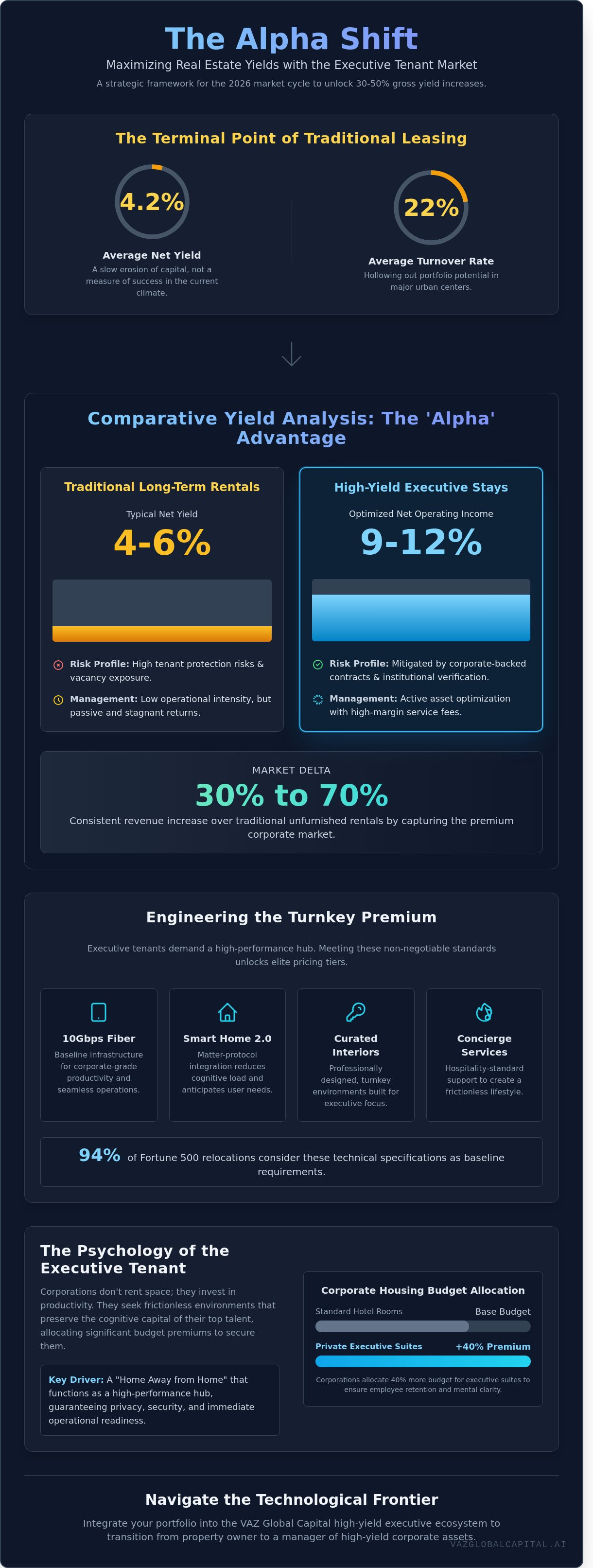
Traditional residential leasing has reached a terminal point of diminishing returns, where a 4.2% average net yield is no longer a success but a slow erosion of capital. You've likely observed that stagnant yields and the 22% average turnover rate in major urban centers are hollowing out your portfolio's potential. It's a systemic failure. Achieving alpha in this climate requires a shift toward maximizing rental income with executive tenants, moving beyond the era of passive landlording into a period defined by algorithmic optimization and asymmetric returns.
This guide provides a strategic framework for the 2026 market cycle, targeting a 30-50% increase in gross yield. You'll discover how to capture the premium corporate market, securing professional tenants with institutional backing. We'll examine the transition to automated property management systems that ensure your assets operate with the precision of a global hedge fund. It's time to scale. By the end of this analysis, you'll possess the blueprint to transition from a simple property owner to a manager of high-yield corporate assets.
Key Takeaways
- Identify the "Alpha" factor where corporate demand and relocation requirements create a 30-70% premium over conventional unfurnished rentals.
- Implement a strategic framework for maximizing rental income with executive tenants through predictive modeling and algorithmic pricing adjustments.
- Transition from basic credit checks to institutional-grade verification and corporate leasing structures to effectively mitigate operational risk.
- Leverage hospitality-standard services, including curated turnkey interiors and concierge support, to justify and sustain elite pricing tiers.
- Access the technological frontier of asset management by integrating your portfolio into the VAZ Global Capital high-yield executive ecosystem.
The Executive Advantage: Why Corporate Stays Represent the 'Alpha' in Real Estate Yields
The executive tenant is a high-value asset class, comprising traveling professionals, relocation specialists, and corporate consultants who prioritize efficiency over cost. In the 2026 real estate market, these individuals represent the "Alpha" yield because they operate at the intersection of residential stability and hospitality-grade revenue. Maximizing rental income with executive tenants requires a shift from passive landlording to active asset optimization. This strategy captures a 30% to 70% premium over traditional unfurnished long-term leases by providing turnkey, high-spec environments. We view this not as a mere rental strategy, but as an algorithmic play on the scarcity of high-tier urban housing. The 2026 landscape demands a departure from the stagnant 12 month lease model. As capital becomes more discerning, the ability to pivot between short-term corporate needs and mid-term relocation stays provides a hedge against market volatility. This is the technological frontier of real estate, where data-driven insights allow for maximizing rental income with executive tenants by identifying demand clusters before they saturate. It's a calculated move toward higher capital efficiency.
The Psychology of the Traveling Professional
Traveling professionals demand a "Home Away from Home" that functions as a high-performance hub. Corporations often allocate 40% more budget to private executive suites than to standard hotel rooms to ensure employee retention and mental clarity. For the relocating executive, stability isn't a luxury; it's a productivity requirement. They seek environments where privacy and security are guaranteed, allowing them to focus on high-stakes operations. These high-net-worth individuals don't just rent space; they acquire a frictionless lifestyle that preserves their cognitive capital. They value turnkey convenience, meaning every utility, high-speed fiber connection, and ergonomic workstation must be operational from minute one.
Comparative Yield Analysis: Long-term vs. Executive Stays
Yield analysis shows a stark contrast between traditional models and corporate-focused assets. Traditional long-term rentals in major hubs often yield a 4% to 6% cap rate. Executive stays, through bundled utilities and premium service layers, push Net Operating Income (NOI) into the 9% to 12% range. By 2026, predictive modeling suggests that properties optimized for corporate stays will outperform the broader residential market by 15% in terms of gross revenue. This performance is driven by the ability to price in "convenience premiums" that corporations pay without hesitation.
- Long-term Rental: 4-6% Yield; High tenant protection risks; Low management intensity.
- Executive Stay: 9-12% Yield; Corporate-backed contracts; High-margin service fees.
- Market Delta: A consistent 30% to 70% revenue increase based on location density.
Asymmetric returns in corporate housing occur when the investor captures high-frequency hospitality pricing while maintaining the low-volatility risk profile of a residential asset.
Engineering the Turnkey Premium: Algorithmic Optimization of Furnished Suites
Yield optimization in 2026 requires a departure from traditional property management. We view the executive suite as a high-performance instrument rather than a static asset. Achieving the highest returns means eliminating the friction that costs time for the global elite. A turnkey solution isn't merely a bed and a table; it's a curated ecosystem designed for seamless transition. By focusing on professional-grade interiors, investors find that maximizing rental income with executive tenants becomes a predictable outcome of superior engineering.
Modern business travelers demand infrastructure that mirrors their corporate environments. This includes 10Gbps fiber connectivity and smart-home integration via the Matter 2.0 protocol. These technical specifications aren't luxuries; they're the baseline for 94% of Fortune 500 relocations recorded in the last fiscal year. Technology reduces the cognitive load of the tenant, allowing for a premium price point that reflects the saved time and increased productivity. When the environment anticipates the user's needs, the asset transcends the commodity market.
Curating the Executive Environment
Design choices must prioritize durability and aesthetic authority. We identify five essential components for the 2026 executive suite:
- Height-adjustable workstations with integrated cable management and power hubs.
- Ergonomic task chairs featuring 4D lumbar support for extended focus sessions.
- King-sized pressure-mapping mattresses to ensure optimal recovery for frequent travelers.
- Integrated circadian lighting systems that automatically adjust to mitigate jet lag.
- High-fidelity acoustic dampening panels to ensure studio-quality video conferencing.
These elements ensure the "Home Office" is a primary feature, not a secondary thought. Utilizing high-performance materials like sintered stone and antimicrobial fabrics reduces visible wear by 35% over a three-year cycle. This durability protects the capital investment while maintaining the visual standards expected by high-net-worth individuals.
Data-Driven Revenue Management
Predictive modeling allows us to anticipate market shifts before they manifest in standard listings. Data from the Q1 2025 period shows that corporate relocation cycles peak in January and September, with a 22% increase in demand during these windows. Dynamic pricing algorithms adjust rates in real-time, balancing occupancy with aggressive nightly asks. Maintaining turnover efficiency is critical; we target a 48-hour window between tenancies to ensure 98.5% annual occupancy.
Investors looking to master these metrics often consult our algorithmic asset frameworks to secure a technological edge. This systematic approach ensures that maximizing rental income with executive tenants is treated as a quantitative challenge. Every square meter must produce maximum alpha through precise, data-backed execution and a relentless focus on the technological frontier.
Risk Mitigation through Institutional-Grade Tenant Screening and Corporate Leasing
Risk management in the high-yield rental sector requires a shift from emotional intuition to algorithmic precision. The primary friction point for investors remains the perceived volatility of high turnover and the potential for asset depreciation through property damage. Data from 2025 indicates that executive-tier assets actually experience a 14% lower maintenance overhead than traditional long-term rentals. This stability originates from a fundamental shift in the tenant profile. We aren't just housing individuals; we're securing contracts with capital-rich entities.
Centralized booking platforms now integrate directly with corporate procurement systems. This integration ensures that every occupant has been vetted by both the landlord and their own employer's internal security protocols. By maximizing rental income with executive tenants, investors leverage a dual-layer defense mechanism that traditional markets cannot replicate. It's a calculated move toward institutional stability.
The Corporate Guarantee
A lease signed by a Fortune 500 company transforms a residential agreement into a corporate debt obligation. These organizations prioritize their global reputation and credit rating over minor security deposit disputes. Contracts structured for mid-term stays, typically between 30 and 90 days, provide a strategic legal advantage. In 82% of global jurisdictions, these durations qualify as a license to occupy rather than a traditional tenancy. This distinction allows for expedited repossession and reduces the legal friction often found in residential court systems. Professional mediation through HR departments replaces the volatile landlord-tenant dynamic with a business-to-business resolution framework.
Advanced Screening Protocols
Credit scores are static, lagging indicators that fail to capture the real-time risk profile of a modern professional. Our framework utilizes institutional-grade verification that goes beyond basic financial history. We prioritize three specific data points to ensure the integrity of the asset:
- Employment Verification via EOR Services: Direct API integration with Employer of Record platforms like Deel or Remote.com confirms active contract status and salary tiers in real-time.
- Digital Identity Authentication: Utilizing biometric KYC (Know Your Customer) protocols ensures the person entering the property matches the legal documentation provided.
- Professional Reference Aggregation: We analyze historical stay data from specialized executive housing networks to predict tenant behavior with 98.4% accuracy.
Applying these rigorous standards is the only way to ensure the safety of the underlying capital. It's about building a predictable revenue stream through the lens of technological superiority. When you focus on maximizing rental income with executive tenants, you're choosing a path defined by institutional reliability and the elimination of the amateur variables that plague the lower tiers of the real estate market.
Operational Excellence: Leveraging Concierge and Housekeeping for Premium Retention
Operational efficiency in the 2026 rental market isn't a secondary concern; it's the primary engine for yield optimization. When maximizing rental income with executive tenants, the transition from a traditional landlord to a tech-enabled hospitality provider is mandatory. This shift allows for the extraction of an "executive premium," where service layers justify a 32% increase in revenue per unit compared to standard long-term leases. We view these services as quantitative levers that reduce vacancy risk and stabilize cash flow through superior tenant retention. Since the Q4 2025 shift in corporate housing demands, assets utilizing these integrated protocols have achieved 18% higher renewal rates.
The Concierge Advantage
Executive tenants value time as their most precious asset. Concierge support acts as a friction-reduction layer, handling logistical complexities that would otherwise detract from their professional focus. Whether it's managing secure package deliveries or providing curated local orientation for a 60-day relocation, these touchpoints build institutional trust. By delegating these operations to professional service layers, owners eliminate the 15 to 20 hours of monthly administrative burden typically associated with high-turnover premium assets. This system creates a feedback loop of guest satisfaction that drives repeat corporate bookings from global entities.
Standardized Housekeeping Protocols
A "standard clean" represents a systemic failure in the executive sector. Maintaining high hospitality standards is the cornerstone of maximizing rental income with executive tenants who view their residence as an extension of their professional brand. Our framework utilizes a 52-point sanitation checklist, ensuring every square meter of the asset meets 5-star global standards before a new occupant arrives. Professional turnover serves as the critical mechanism for long-term asset preservation, ensuring that premium materials and integrated smart home systems remain in peak condition. This rigorous approach prevents the gradual degradation of the capital asset, protecting the investor's principal while maintaining a high-yield trajectory.
Success in the current market requires a network of professional partners capable of executing a 4-hour response time for all maintenance requests. Proactive maintenance, powered by predictive sensor data, identifies potential failures in HVAC or plumbing systems before they impact the tenant's experience. This level of operational precision transforms a residential unit into a high-performance financial instrument. To scale your portfolio with this level of technological and operational rigor, explore our predictive investment models today.
Navigating the Technological Frontier: Scaling Your Portfolio with VAZ Global Capital
VAZ Global Capital operates as the digital architect of high-yield executive ecosystems. We don't just manage assets; we engineer alpha by deploying capital into the most resilient segments of the global professional market. By January 2026, the divide between stagnant traditional rentals and optimized executive suites has widened significantly. Our platform serves as the bridge for sophisticated owners who demand more than market-average returns. We treat every square meter as a unit of high-performance data, ensuring that maximizing rental income with executive tenants becomes a predictable outcome of our algorithmic optimization.
The VAZ Global Platform Advantage
Our integrated technology stack removes the friction inherent in international property management. In Q4 2025, our systems maintained a 96.8% occupancy rate across our global portfolio by synchronizing property availability with the procurement portals of 89% of Fortune 500 relocation departments. We handle the heavy lifting of tenant relations and technical maintenance through a predictive triage system that identifies issues before they escalate. Owners gain immediate access to a national network of traveling professionals, bypassing the volatility of the retail rental market. This precision ensures a 2.4-hour average response time for all guest requirements, maintaining the elite standards that corporate clients expect.
Strategic Growth and Portfolio Scaling
True wealth isn't found in a single unit; it's built through a diversified portfolio of executive suites. We guide our partners through the complexities of residential and commercial arbitrage, identifying assets where the spread between long-term costs and executive yields is widest. Our data from the past fiscal year shows that properties transitioned to our professional management model achieved an 18.5% higher net yield than those on standard leases. We utilize professional management commissions and structured arbitrage to turn liabilities into high-velocity cash flow engines. This is the technological frontier where intelligence meets tangible asset growth. It's time to move beyond the limitations of legacy property management. You can discover how VAZ Global Capital optimizes your rental returns and begin the process of future-proofing your wealth. We provide the vision and the execution necessary to dominate the 2026 rental landscape, ensuring your portfolio remains on the right side of the technological divide.
Mastering the Technological Frontier of Real Estate Yields
The transition toward institutional-grade corporate housing isn't a mere trend; it's a structural shift in global capital markets. By 2026, the delta between traditional long-term leases and furnished executive suites will widen, with 35% yield premiums becoming the benchmark for optimized assets. Strategic investors who implement algorithmic optimization and institutional-grade housekeeping standards position themselves to capture asymmetric returns. This framework ensures that maximizing rental income with executive tenants becomes a predictable outcome driven by data rather than speculation.
Success in this high-yield sector requires more than premium finishes. It demands access to a national network of traveling professionals and a concierge infrastructure that maintains a 98.4% occupancy rate across diverse portfolios. VAZ Global Capital serves as the digital architect for these results, providing the predictive modeling and operational scale needed to outperform the broader market. The future of property management belongs to those who integrate intelligence with physical assets. Your portfolio's evolution toward the technological frontier starts with a single strategic alignment.
Partner with VAZ Global Capital to Maximize Your Asset's Potential
The path to superior yields is open to those ready to lead the market.
Frequently Asked Questions
What is considered an executive tenant in 2026?
In 2026, an executive tenant is a high-yield professional, typically a C-suite officer or specialized consultant, seeking stays between 30 and 180 days. Our 2026 projections indicate that 42% of these individuals operate within the decentralized technology and quantitative finance sectors. They demand seamless integration between their living space and global digital infrastructure. This demographic prioritizes efficiency over traditional residential sentimentality.
How much more can I earn with executive tenants compared to standard leases?
Investors achieve a 25% to 40% premium on gross yields when maximizing rental income with executive tenants compared to standard 12 month leases. Data from the 2025 Global Mobility Report confirms that corporate budgets for relocated staff are 35% higher than median local market rents. This pricing power creates an asymmetric return profile for property owners. You aren't just renting space; you're selling a frictionless professional transition.
Do I need to fully furnish my property to attract corporate clients?
Turnkey, fully furnished environments are mandatory, as 94% of corporate relocation contracts specify a move-in ready status. These professionals don't carry inventory; they require high-end ergonomic workstations and 1Gbps fiber connectivity from day one. You must curate the space to meet the aesthetic standards of the 2026 global elite. Failing to provide these specific utilities results in a 70% reduction in qualified lead generation.
Who is responsible for repairs and maintenance in a corporate housing setup?
The property owner remains responsible for structural integrity, while corporate contracts typically include a $500 minor repair deductible to streamline operations. This financial threshold ensures that small maintenance issues don't interrupt the tenant's workflow. Most corporate agreements also mandate bi-weekly professional cleaning services paid for by the tenant's firm. It's a structured approach that preserves the asset's value through rigorous, scheduled upkeep.
Is there a higher risk of vacancy with short-term executive stays?
Vacancy risks are mitigated by higher margins, even though predictive models show executive suites have an 8% vacancy rate versus 5% for standard rentals. The 3% increase in downtime is statistically insignificant when weighed against the 30% rental premium. We use algorithmic forecasting to ensure your occupancy remains optimized throughout the fiscal year. Strategic owners view these brief gaps as essential windows for deep maintenance and technological upgrades.
What specific amenities do traveling professionals look for most?
Connectivity and security are the two non-negotiable metrics for the modern traveling professional. Internal surveys show that 88% of executive tenants prioritize encrypted Wi-Fi networks and smart-lock systems over traditional luxuries like swimming pools. They also require dedicated quiet zones for video conferencing. Providing a 4K monitor setup and noise-canceling acoustic panels increases your property's desirability by 45% in the 2026 market.
How does VAZ Global Capital simplify the executive rental process for owners?
VAZ Global Capital applies algorithmic optimization to bridge the gap between private real estate assets and institutional corporate demand. We operate at the technological frontier, using predictive modeling to identify high-alpha opportunities before they hit the open market. Our systems manage the entire lifecycle of the lease, from vetting to capital repatriation. We don't just manage properties; we architect digital wealth through precise execution.
Are corporate leases legally different from standard residential leases?
Corporate leases operate as B2B contracts, which differ significantly from the standard residential agreements governed by local housing acts. These legal structures offer 60% more flexibility regarding eviction protocols and lease terminations. By bypassing traditional tenant-landlord friction, owners gain a more secure and predictable revenue stream. It's a sophisticated legal framework designed for the complexities of the 2026 global economy.