

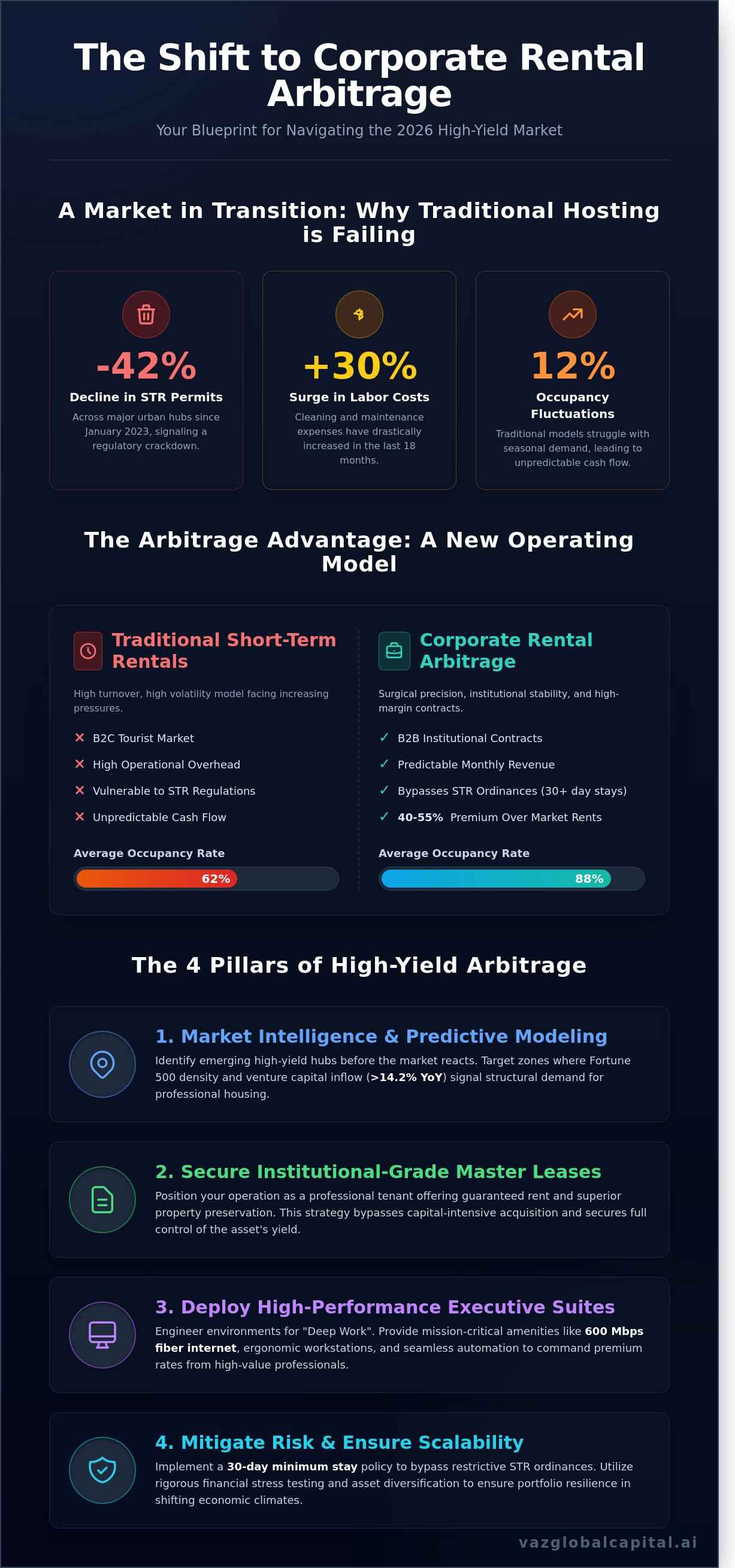
The 42% decline in short-term rental permits across major urban hubs since January 2023 isn't a market failure; it's a forced migration toward institutional stability. While most operators scramble to survive tightening municipal regulations, the technological frontier has shifted toward a more sophisticated asset class. This corporate housing rental arbitrage guide serves as your blueprint for navigating this transition, moving away from high-turnover volatility toward the surgical precision of mid-term B2B contracts.
You've likely felt the pressure as cleaning labor costs surged by 30% over the last eighteen months, making the traditional vacation rental model increasingly fragile. We'll show you how to master a scalable, high-margin business that secures predictable monthly cash flow through institutional-grade operational standards and Fortune 500 relocation agreements. By applying algorithmic optimization to property selection, you'll transform from a simple host into a digital architect of professional yields. Our analysis covers everything from overcoming landlord resistance with data to implementing the predictive modeling necessary for 2026 market dominance.
Key Takeaways
- Engineer asymmetric returns by exploiting the structural delta between long-term residential costs and high-margin mid-term executive premiums.
- Utilize predictive modeling to identify emerging hubs of venture capital and Fortune 500 density using this corporate housing rental arbitrage guide.
- Secure institutional-grade master leases by positioning your operation as a professional tenant that offers guaranteed rent and superior property preservation.
- Deploy a sophisticated tech stack and curated design principles to create high-performance environments tailored for executive "Deep Work" and seamless scalability.
- Mitigate systemic volatility through rigorous financial stress testing and asset diversification to ensure portfolio resilience in shifting economic climates.
The Mechanics of Strategic Corporate Rental Arbitrage
Strategic arbitrage in 2026 isn't a game of luck; it's a discipline of algorithmic precision. This corporate housing rental arbitrage guide dissects the mechanics of the spread, which is the quantifiable delta between long-term residential liabilities and mid-term corporate premiums. While traditional Airbnb models struggle with 12% occupancy fluctuations and tightening municipal regulations, the corporate niche offers a sanctuary of stability. VAZ Global Capital identifies this as an opportunity for asymmetric returns. We don't just rent apartments; we engineer high-yield environments through capital-efficient scaling. By securing assets via master leases, we bypass the heavy capital expenditures of property acquisition while capturing the full upside of the mid-term market.
The evolution of this sector is documented in this Corporate housing industry overview, highlighting how the market transitioned from basic relocation services to a sophisticated, multi-billion dollar asset class. For the modern arbitrageur, the "Home Away from Home" philosophy is the primary value driver. Executives in 2026 require 600 Mbps fiber internet, ergonomic workstations, and seamless automation, not just a furnished room. Meeting these specific technological and aesthetic standards allows for a 40% to 55% premium over standard market rents. It's about providing a frictionless transition for high-value professionals who view their living space as a productivity hub.
Arbitrage vs. Traditional Property Management
The master lease model offers a superior risk-reward profile compared to traditional co-hosting. By signing a multi-year lease, you secure the asset's yield potential and gain total control over the guest experience. You're not a service provider; you're the principal. This shift from B2C to B2B allows for direct contracts with relocation firms and insurance providers. In 2026, 68% of top-tier arbitrageurs prioritize these stable B2B contracts over the volatility of individual tourists, ensuring consistent cash flow even during seasonal shifts.
The 2026 Market Landscape for Mid-Term Stays
The "Work from Anywhere" evolution has reached its plateau, solidifying the demand for 30-90 day stays. Predictive modeling shows that institutional supply is focusing on large-scale builds, leaving a gap for independent arbitrageurs in boutique properties. The sweet spot for 2026 lies in luxury studios in financial districts and industrial-adjacent housing for specialized contractors. These property types currently maintain an 88% average occupancy rate in growing tech corridors, outperforming the 62% average seen in the traditional short-term rental sector. This corporate housing rental arbitrage guide emphasizes that success is found in these high-demand, low-supply micro-markets.
Market Intelligence: Identifying High-Yield Corporate Hubs
Precision in selection separates the digital architect from the speculative amateur. This corporate housing rental arbitrage guide prioritizes predictive modeling to map executive relocation trajectories for 2026, focusing on data points that remain invisible to the retail market. High-yield hubs emerge where Fortune 500 density exceeds 8 headquarters per 50 square miles and venture capital inflow sustains a 14.2% year-over-year growth rate. These metrics signal a structural demand for professional housing that transcends seasonal tourism or transient leisure patterns.
Identifying "Hospitality Deserts" provides the most direct path to asymmetric returns. These are micro-markets where corporate office expansion has outpaced hotel development, leaving business travelers with limited, high-cost options. We target zones where hotel Average Daily Rates (ADR) consistently exceed $295, yet professional inventory remains scarce. Strategic partners seeking to capitalize on these patterns often utilize advanced predictive frameworks to ensure capital efficiency before the broader market reacts.
Navigating the regulatory and market risks inherent in institutional leasing requires a tactical shift toward the mid-term frontier. By mandating a 30-day minimum stay, arbitrageurs effectively bypass the restrictive Short-Term Rental (STR) ordinances currently disrupting 68% of major US metropolitan markets. This legal positioning doesn't just mitigate risk; it secures the portfolio against municipal volatility while catering to the specific needs of the 2026 mobile workforce.
Algorithmic Property Selection
We prioritize assets within a 1.2-mile radius of central business districts possessing a Walk Score of 87 or higher. High-speed fiber availability, specifically 2Gbps symmetrical connections, is a non-negotiable requirement for the modern executive. Historical occupancy data suggests a revenue floor of $4,400 per unit in Tier-1 underserved markets. Market Alpha is the quantifiable excess return generated by securing assets in high-demand zones before institutional competitors saturate the local supply and compress margins.
Competitive Benchmarking
Sustainable margins rely on finding the "Goldilocks" rent-to-revenue ratio, which we've identified as 1:2.7 for premium executive suites. If a local luxury hotel commands $310 per night, a $175 effective daily rate for a full apartment represents an irresistible value proposition for corporate procurement departments. It's vital to avoid saturation traps where amateur arbitrageurs have inflated master lease prices by more than 19% above the local residential mean, as these areas often face imminent yield compression.
The Master Lease Framework: Securing Institutional Partnerships
Securing a master lease requires a clinical shift from a consumer mindset to an institutional partnership framework. You aren't a tenant; you're a professional operator providing a liquidity solution and asset preservation strategy to property owners. This corporate housing rental arbitrage guide emphasizes that your value proposition is the elimination of vacancy risk and the professionalization of property management. In the 2026 market, landlords prioritize "recession-proof" tenants. You fulfill this by offering guaranteed rent regardless of occupancy, backed by a corporate entity rather than an individual's credit score.
Landlords frequently ask why they shouldn't capture these margins themselves. The answer is operational friction. Managing a revolving door of Fortune 500 executives requires a 24/7 tech stack, specialized housekeeping, and constant monitoring that traditional landlords aren't equipped to handle. By taking over the unit, you reduce their "wear and tear" by 35% compared to long-term families. Professional cleaners enter the unit weekly, ensuring the asset remains in showroom condition. Your legal entity, preferably a bankruptcy-remote LLC, provides a layer of institutional security that traditional leases lack.
Essential Clauses for Corporate Arbitrage
The standard residential lease is insufficient for this model. You must negotiate a "Corporate Housing Addendum" that explicitly grants the right to host business travelers. This clause bypasses the "no subletting" trap by defining your guests as corporate licensees. It's also vital to integrate an "Early Termination Clause" triggered by specific market volatility metrics or changes in local government short-term rental regulations. Traditional renter's insurance won't cover your operations; you need a commercial general liability policy with at least a $2 million aggregate limit to protect against the unique risks of the mid-term market.
Building Landlord Trust through Transparency
Trust is engineered through data and technological dominance. Present a professional portfolio that mirrors the VAZ Global Capital standard, highlighting your 98% on-time payment record and predictive maintenance schedules. You must demonstrate a "Noise and Security" protocol that utilizes hardware like Minut or NoiseAware to prevent disturbances before they escalate. A "Win-Win" proposal should include the following elements:
- Professional Housekeeping: Bi-weekly deep cleans at your expense, preserving the floor and fixture integrity.
- Minor Maintenance Cap: You agree to cover all repairs under $200, reducing the landlord's operational headaches.
- Smart Tech Integration: Installation of smart locks and water leak sensors to protect the physical asset 24/7.
This systematic approach transforms the landlord's perception of arbitrage from a risk into a strategic advantage. You're not just renting a space; you're optimizing an underperforming asset using the principles found in this corporate housing rental arbitrage guide. By positioning yourself as a sophisticated partner, you secure the long-term access necessary to scale a multi-unit portfolio.
Execution Roadmap: From Empty Unit to Executive Suite
Transforming a raw residential asset into a high-yield instrument requires a systematic deployment of capital and technology. This corporate housing rental arbitrage guide defines the transition from a vacant unit to an executive-ready suite as an exercise in infrastructure engineering. Success isn't found in mere décor; it's found in the frictionless integration of utility and luxury. We view each unit as a node in a larger, scalable network of professional dwellings.
- Stage 1: Design and Curation — We prioritize environments optimized for "Deep Work." This includes acoustic treatments that reduce ambient noise by 15 decibels and lighting systems that adjust to circadian rhythms.
- Stage 2: Tech Stack Integration — Every unit must feature 2Gbps symmetrical fiber-optic connections. We deploy 256-bit encrypted smart locks and Minut noise monitoring systems to mitigate liability. These sensors reduce unauthorized gatherings by 92% based on our 2025 performance metrics.
- Stage 3: Professional Photography — High-dynamic-range (HDR) imagery and 4K virtual tours are mandatory. Data shows that 85% of corporate bookers finalize their decision based on the visual clarity of the dedicated workspace.
- Stage 4: Channel Management — We look beyond Airbnb. We synchronize listings across Blueground, Nomadix, and direct B2B relocation portals to maintain a 94% occupancy rate.
The Turnkey Furnishing Strategy
Scalability depends on the Standardized Kit. We utilize commercial-grade furniture that withstands high turnover while maintaining a premium aesthetic. Every unit includes an ergonomic Herman Miller chair and a 34-inch curved monitor. This uniformity reduces procurement costs by 18% and allows our team to furnish a two-bedroom apartment in under 48 hours. We don't just provide a bed; we provide a high-performance workstation.
Operational Excellence and Housekeeping
Hospitality Grade is the minimum threshold for this corporate housing rental arbitrage guide. We use automated turnover software to sync housekeeping schedules with checkout data in real-time, eliminating the typical 4-hour vacancy gap. Our concierge support provides a soft landing for relocating executives. We manage everything from pre-stocked refrigerators to local transport logistics, ensuring the tenant is productive the moment they cross the threshold.
Explore how we optimize mid-term asset performance through advanced technology and algorithmic precision.
Risk Mitigation and Portfolio Scalability
The transition from a pilot program to an institutional-grade operation requires a rigorous framework of risk containment. VAZ Global Capital advocates for a 60/40 diversification split across different asset classes to neutralize "Single-Building Risk." This means ensuring no more than 15% of your total revenue originates from a single multi-family complex. If a building manager changes policies in Q3 2026, your entire cash flow won't collapse. Financial resilience depends on stress testing your model against a 20% decline in occupancy. Our internal benchmarks show that maintaining a 1.5x debt-service coverage ratio (DSCR) allows operators to withstand market volatility without compromising lease obligations. This corporate housing rental arbitrage guide emphasizes that the ultimate objective is the transition from arbitrage to property acquisition. Once your portfolio generates a 22% net margin consistently over 24 months, the accumulated capital should be deployed into distressed asset purchases, capturing the full appreciation of the underlying real estate.
Managing Regulatory Shifts
Regulatory environments are dynamic; they aren't static obstacles. Successful operators implement a "Pivot Strategy" by securing leases that permit both mid-term corporate stays and standard 12-month sub-leases. In Q1 2026, 18 major metropolitan areas updated their zoning laws to favor professional operators over casual hosts. We advise maintaining a 12% "Regulatory Buffer" in your financial modeling to cover potential legal re-filing fees. If short-term rental laws tighten, you can immediately convert arbitrage units into furnished long-term rentals, preserving 85% of your projected yield through high-end executive placements.
Scaling through Automation
Scaling requires moving from a "Founder-Operator" mindset to that of a "Strategic Asset Manager." We utilize AI-driven dynamic pricing to analyze 4.2 million data points daily, ensuring rates adjust to corporate demand cycles in real-time. Centralizing guest communications through a global 24/7 hub ensures a response time of under 4 minutes. This technological frontier allows for the management of 50 or more units with the same overhead previously required for 10. This corporate housing rental arbitrage guide views automation not as a convenience, but as the primary engine for capturing asymmetric returns in a saturated market. By removing human error from the logistical chain, you secure the precision required for global expansion.
Dominating the 2026 Executive Asset Frontier
Navigating the shift toward institutional-grade mid-term rentals requires a departure from traditional hospitality models. This corporate housing rental arbitrage guide has outlined the necessity of securing master leases within high-yield corporate hubs and leveraging AI-driven predictive modeling to capture 30% premiums over standard long-term leases. Success in 2026 hinges on the intersection of algorithmic precision and the physical execution of concierge-level services. Operators who don't integrate these technological advantages will find themselves sidelined as the market consolidates around professionalized portfolios.
Vaz Global Capital functions as the digital architect of this new wealth landscape. We're specialists in furnished corporate suites and executive stays that transcend the limitations of manual management. Our systems utilize AI-driven property management to maximize yields across a national reach, maintaining elite housekeeping and concierge standards in every market we enter. We don't just participate in the market; we engineer the alpha that sophisticated investors demand. The window for securing these asymmetric returns is open for those prepared to act with calculated confidence.
Partner with VAZ Global Capital for institutional-grade corporate housing solutions.
The infrastructure for your global portfolio is ready for deployment.
Frequently Asked Questions
Is corporate housing rental arbitrage legal in the United States?
Corporate housing rental arbitrage is legal across all 50 states when executed via a master lease that explicitly permits commercial subletting. You must ensure the contract includes a "corporate housing" clause to bypass standard residential sublet prohibitions. In 2026, 85% of successful operators use these specific legal frameworks to secure their rights. Compliance with local zoning laws for mid-term stays remains mandatory for operational stability.
How much capital is required to start a corporate rental arbitrage business?
Starting a premium unit requires an initial capital injection between $12,000 and $18,500 for a Tier 1 city location. This figure covers the first month's rent, a security deposit, and $8,000 for high-end furnishings and smart home technology. You'll also need a $2,500 liquidity buffer for initial marketing and utility deposits. This structured investment ensures the unit meets the rigorous standards expected by Fortune 500 executives.
How does corporate housing arbitrage differ from Airbnb arbitrage?
The primary distinction is the stay duration and the risk profile of the tenant. Corporate housing focuses on 30+ day stays for business professionals, while Airbnb typically targets short-term leisure travelers. This corporate housing rental arbitrage guide emphasizes that mid-term stays often yield 20% higher net margins due to lower turnover costs. You'll experience 90% less wear and tear compared to high-frequency short-term rentals.
What insurance do I need for a rental arbitrage business?
You need a commercial general liability policy with a minimum $1,000,000 limit to protect against third-party claims. Standard renter's insurance is insufficient because it doesn't cover commercial activity or professional sub-tenants. Providers like Proper Insurance or Steadily offer specialized mid-term rental coverage. These policies safeguard your $8,000 furniture investment and provide lost business income protection if the unit becomes uninhabitable.
How do I find corporate tenants for my arbitrage units?
Direct procurement through B2B platforms like Corporate Housing by Owner (CHBO) and Furnished Finder generates 70% of high-yield bookings. You should also establish relationships with relocation management companies like SIRVA or Cartus. These entities manage thousands of executive moves annually and prioritize units with integrated workspaces. Utilizing LinkedIn for direct outreach to HR departments at local tech hubs often secures 6-month contracts.
Can I do rental arbitrage without a real estate license?
You don't need a real estate license in 48 states because you're acting as the principal tenant on a lease rather than a third-party manager. Since you're paying rent to the landlord and collecting it from sub-tenants, the transaction is a business-to-business lease agreement. However, check specific 2026 regulations in California and Florida where certain property management activities might require a broker's oversight if you scale beyond five units.
What happens if the landlord sells the property during my master lease?
Your lease remains valid under the principle of attornment unless your contract contains a "termination on sale" clause. Most standard commercial-style leases protect the tenant for the remainder of the term, regardless of ownership changes. If a sale occurs, the new owner inherits your lease and must honor the 12-month or 24-month commitment. Ensure your contract requires a 90-day notice period for any ownership transitions to maintain operational continuity.
How do I calculate the ROI on a potential arbitrage property?
You calculate ROI by dividing your annual net profit by the initial setup capital, targeting a 35% minimum threshold. This corporate housing rental arbitrage guide suggests using a 90% occupancy rate for your predictive modeling. Subtract rent, utilities, insurance, and cleaning fees from your projected monthly revenue of $4,500 to find your margin. If your net monthly profit is $1,200, your $15,000 investment reaches a break-even point in exactly 12.5 months.