

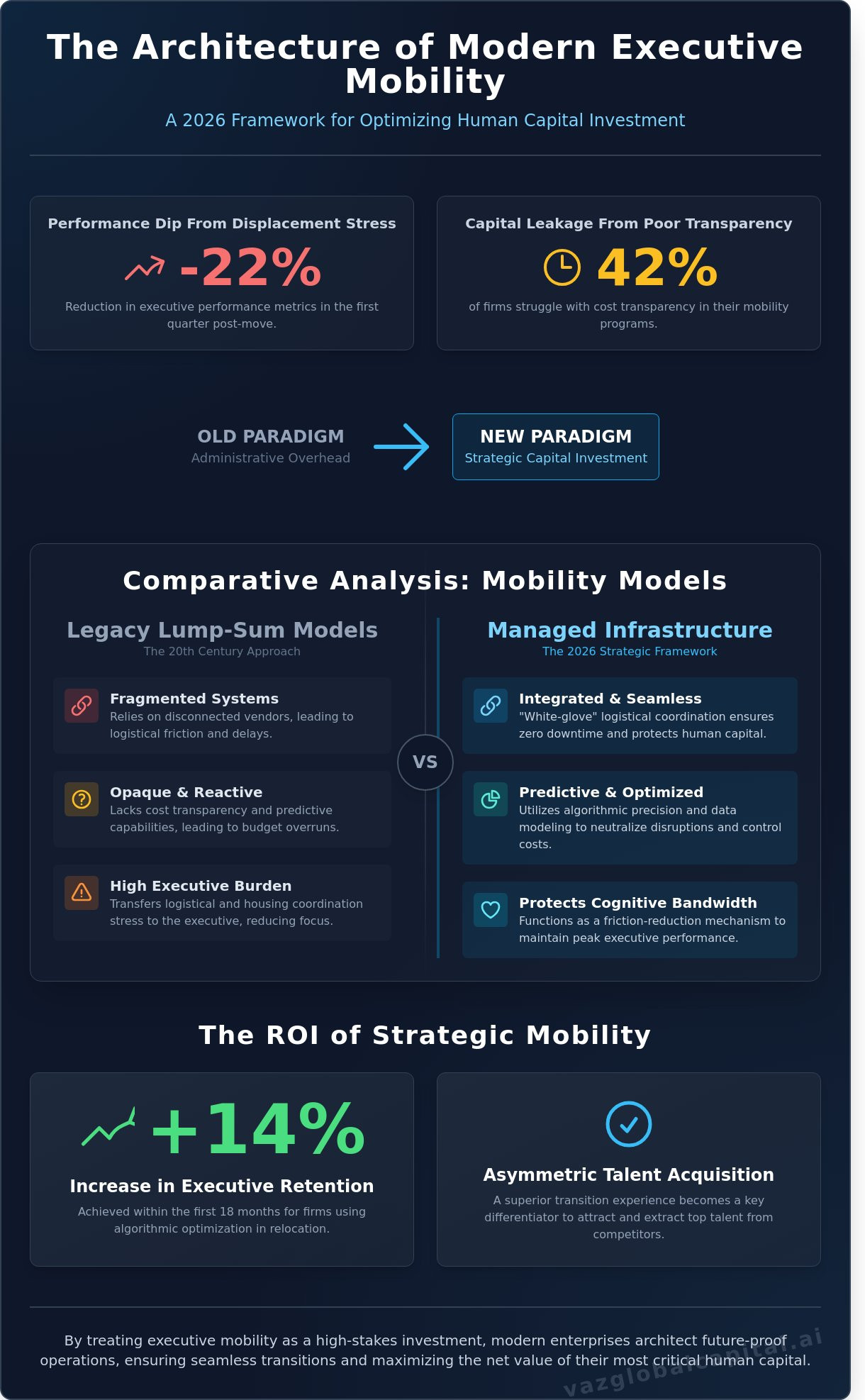
A standard relocation package in 2026 isn't a mere corporate perk; it's a precision instrument that dictates the success of a high stakes executive deployment. Data from the 2024 Cartus Global Mobility report indicates that 42% of firms still struggle with cost transparency, leading to significant capital leakage during market transitions. You understand that professional displacement involves more than physical transit. It's a complex recalibration of human capital where fragmented logistics and housing quality variance can quickly compromise an executive's performance.
We'll show you how to master the architecture of modern mobility to ensure seamless transitions and human capital optimisation. You'll learn to eliminate the friction of professional displacement while preserving the exact lifestyle standards your top talent expects. This article provides a strategic blueprint for using predictive modelling and algorithmic precision to maximise the net value of every relocation offer. We'll examine the specific frameworks that turn executive mobility into a scalable, future-proof asset for your global operations.
Key Takeaways
- Reframe the modern relocation package as a high-yield strategic asset designed to optimize human capital and ensure seamless executive continuity.
- Identify why white-glove logistical coordination and premium furnished suites outperform traditional hospitality in the pursuit of professional efficiency.
- Analyze the structural divergence between lump-sum models and managed infrastructure to determine which framework offers the ultimate institutional advantage.
- Master the tactical negotiation points necessary to align corporate mobility offers with the rigorous standards of global executive performance.
- Understand how technological innovation is architecting the future of residential executive suites for the sophisticated traveling professional.
Redefining the Relocation Package as a Strategic Capital Investment
By 2026, the traditional view of moving expenses has been replaced by a sophisticated relocation package model that mirrors the precision of a private equity acquisition. This suite of assets represents a calculated deployment of capital, integrating financial liquidity with logistical precision to ensure zero downtime for high-value human assets. The shift from 20th-century reimbursement models to current integrated mobility frameworks is absolute. Modern enterprises no longer view these costs as administrative overhead; they treat them as a mechanism for asymmetric talent acquisition. By providing a superior transition experience, firms can extract talent from competitors who still rely on fragmented, legacy systems.
Strategic mobility now relies on predictive modeling to determine the efficiency of every move. Data from 2024 industry benchmarks indicates that companies utilizing algorithmic optimization in their Relocation service procurement saw a 14% increase in executive retention during the first 18 months of tenure. This isn't merely about logistics; it's about protecting the firm's most volatile and valuable investment: its leadership. The 2026 framework treats the executive as a high-performance engine that requires a controlled environment to function during transit.
The Evolution of Professional Mobility
The technological frontier has redefined what executives expect from their employers. The move toward "Turnkey Mobility" ensures the professional remains focused on output while the system handles the variables of displacement. In this environment, the professional's cognitive bandwidth is the currency being protected. Firms that fail to automate the friction of moving will find their talent pool shrinking as mobility becomes a standard expectation of the executive tier. The modern relocation package functions as a high-precision friction-reduction mechanism designed to maintain executive cognitive load at peak performance during geographical transitions.
Human Capital Optimisation in 2026
Quantifying the ROI of a seamless executive transition is now a matter of algorithmic precision. A study from the 2025 Global Mobility Forum indicated that displacement stress can reduce executive performance metrics by 22% in the first quarter post-move. This performance dip represents a significant loss in strategic momentum. Superior housing acts as the primary lever for successful relocation, serving as the anchor of stability in a shifting professional landscape. When an executive's domestic environment is optimized through pre-vetted, high-tier real estate, their professional output remains consistent. This stability isn't a luxury; it's a requirement for maintaining the pace of global commerce.
The Core Architecture of a High-Performance Relocation Framework
Constructing a 2026-grade relocation package requires moving beyond the archaic checklist of moving trucks and basic stipends. It's a strategic deployment of human capital that demands the same level of precision as a high-frequency trading algorithm. The framework must eliminate logistical friction while ensuring that the executive's cognitive load remains focused on global market expansion rather than the minutiae of physical transition. Effective Managing Employee Relocation protocols now integrate sophisticated data modeling to predict and neutralize potential disruptions before they impact the balance sheet.
Logistical Precision and Asset Management
The physical transition of an executive's life is an exercise in high-stakes asset management. We don't just move boxes; we orchestrate the secure transfer of high-value assets with real-time telemetry and comprehensive insurance coverage. Modern mobility frameworks utilize algorithmic route and timing optimization to circumvent geopolitical bottlenecks and supply chain delays that plagued the early 2020s. A critical component of this phase is the seamless integration of temporary corporate housing, which provides a controlled environment for the executive while permanent arrangements are finalized. This phase relies on:
- White-glove coordination for sensitive assets, including private art collections and proprietary hardware.
- Predictive scheduling that aligns arrival times with local market operational hours.
- End-to-end digital tracking that offers 100% transparency of the transition pipeline.
The Housing Standard: Furnished Executive Suites
Traditional hotels are insufficient for the 2026 leader. They lack the privacy, dedicated secure connectivity, and spatial design required for sustained high-level performance. Furnished executive suites have become the non-negotiable standard because they offer a "home away from home" experience that preserves the leader's routine. In markets like London or New York, where premium vacancy rates stayed below 2.1% throughout 2025, securing month-to-month flexibility in high-demand districts is a strategic necessity. These suites must meet rigorous criteria for design excellence and technological infrastructure, ensuring that the executive's transition doesn't result in a dip in productivity.
Financial integrity within the relocation package is maintained through precise tax equalization and Cost-of-Living Adjustments (COLA). These aren't mere perks; they're essential buffers that protect the executive's purchasing power across disparate economic zones. When combined with lifestyle continuity assets, such as spousal career support and community integration programs, the risk of assignment failure drops significantly. Data from 2024 suggests that 42% of relocation failures were tied to family integration issues, making these "soft" assets a hard requirement for ROI. Those interested in optimizing your executive capital should view these components as essential pillars of a future-proof mobility strategy.
Comparative Analysis: Lump Sum Models vs. Managed Infrastructure
Organizations frequently view the relocation package as a binary choice between capital liquidity and operational oversight. The lump sum model promises simplicity; it provides a single cash injection intended to cover all transition costs. While this appeals to budgetary predictability, it creates a significant cognitive load for the executive. They become a temporary project manager instead of a strategic leader. This shift in focus is a misallocation of high-value human capital.
The Paradox of the Lump Sum
Cash-in-hand often results in sub-optimal outcomes. Without institutional data, executives typically overpay for housing by 15% to 22% in tier-one global cities like Singapore or Zurich. The administrative tax is equally severe. Data from 2024 mobility benchmarks indicates that unmanaged relocations consume approximately 80 to 120 hours of a professional's productive time. Predictive modeling suggests that for a C-suite executive, this "DIY" approach represents a hidden loss of nearly $50,000 in strategic value. It's an inefficient use of resources that ignores the complexities of local markets.
Managed Executive Mobility
Sophisticated enterprises leverage the institutional advantages of corporate relocation companies to eliminate these inefficiencies. These entities provide access to off-market housing inventory and vetted logistics chains that are inaccessible to individuals. Integrating corporate quarters into the mobility strategy ensures that the executive remains focused on their core mandate from day one. Standardized service levels across national borders mitigate the friction of international transitions, ensuring that the caliber of support remains consistent regardless of the destination's geographic coordinates.
Hybrid frameworks represent the technological frontier of the relocation package. By combining a fixed allowance with a curated network of service providers, firms achieve a balance of autonomy and precision. This algorithmic optimization of resources ensures that capital is deployed where it generates the highest return on human performance. The following factors distinguish managed infrastructure from the lump sum approach:
- Risk Mitigation: Managed models absorb the volatility of local real estate and service pricing.
- Time Recovery: Professionals bypass the 100+ hours usually required for logistics coordination.
- Quality Control: Institutional partnerships guarantee a baseline of luxury and security that individual searches cannot match.
- Data Integration: Managed services provide the corporation with granular data on relocation spend, allowing for future budget refinement.
Choosing between these models isn't merely a matter of HR policy; it's a strategic decision regarding the preservation of executive momentum. A move shouldn't be a disruption. It should be a seamless transition facilitated by superior intelligence and infrastructure.
Tactical Negotiation: Securing the Alpha in Global Mobility
Negotiation in the executive sphere is a precise calculation of risk and performance. It isn't a plea for comfort; it's the algorithmic removal of friction. When finalizing a relocation package, your leverage lies in the scarcity of high-tier leadership and the high cost of vacancy. Data from 2025 mobility reports suggests that executive displacement costs corporations up to 213 percent of the annual salary in lost productivity and operational delays. Use these metrics to frame your demands. Securing the alpha means ensuring every logistical detail serves your cognitive capacity and protects your time.
- Leverage Points: Identify the specific business impact of your immediate availability. If your arrival stabilizes a volatile market or accelerates a product launch, your negotiation power increases.
- Soft Asset Bundling: Request "cognitive load reducers" such as housekeeping, professional concierge services, and pre-configured utility bundling. These aren't perks; they're essential tools for maintaining focus.
- Payback Clause Protection: Standard clauses often demand full repayment if you leave within 24 months. Negotiate a "pro-rata" schedule or total exemption for lateral moves and internal restructures.
The Art of the Mobility Ask
Frame your requirements as a necessity for peak performance rather than a list of personal preferences. Demand specific providers like VAZ Global Capital to ensure housing quality meets the required technological and aesthetic threshold. This isn't vanity. It's the mitigation of environmental variables that threaten your output. A comprehensive package must account for the total cost of professional displacement, including the loss of established local networks and the immediate need for a functional, high-bandwidth environment.
Future-Proofing Your Transition
Standard 30-day temporary housing windows are insufficient for strategic decision-making in 2026. Negotiate for a minimum of 90 days to ensure permanent residency choices align with long-term wealth preservation goals. If your role requires a hybrid presence, incorporate commercial flex-space or dedicated home-office upgrades into the residential agreement. This ensures your professional infrastructure is operational from day one. Strategic negotiation is the final act of executive due diligence, transforming a standard contract into a blueprint for sustained high-performance output.
Secure your professional transition with the precision of AI-driven property management. Optimize your relocation with VAZ Global Capital.
VAZ Global Capital: Architecting the Future of Furnished Executive Suites
VAZ Global Capital operates at the intersection of quantitative finance and high-end residential real estate. We've redefined the relocation package by applying algorithmic optimization to executive mobility. Our approach isn't merely about providing a roof; it's about deploying a sophisticated technological frontier that anticipates the needs of the 2026 global workforce. By leveraging predictive modeling, we identify and secure premier assets in key economic hubs before market demand peaks, ensuring our clients maintain a persistent competitive advantage.
Our furnished suites represent the pinnacle of professional housing. We eliminate the friction inherent in national professional relocation by standardizing excellence across every zip code we touch. Each property undergoes a rigorous 50-point technological audit, ensuring 1-gigabit connectivity and seamless smart-home integration. This precision-engineered environment allows executives to maintain peak performance from the moment they cross the threshold. We've integrated professional housekeeping and 24/7 concierge support as non-negotiable standards, treating every stay with the gravity of a high-stakes financial transaction.
The Home Away From Home Experience
We curate residential units designed specifically for the modern executive mindset, where the boundary between life and work is fluid but demanding. Our proprietary digital platform manages the entire lifecycle of a stay, from algorithmic booking to real-time maintenance requests. This system removes human error and administrative lag. For those navigating the complexities of the Silicon Valley market, linking the transition to our corporate housing guide provides the granular insight necessary for a successful deployment.
Scalable Solutions for the Global Enterprise
Global enterprises partner with VAZ to standardize their executive housing footprint across the United States. We provide a unified relocation package framework that scales effortlessly from single deployments to large-scale leadership transitions. Our commitment to privacy and medical-grade sanitation protocols reflects the institutional weight of our brand. In a market defined by volatility, VAZ Global Capital serves as the strategic ally that secures your human capital's environment. We don't just host professionals; we provide the architectural stability required for global expansion.
- Asymmetric Reliability: 99.9% uptime on all essential residential technologies and utilities.
- Strategic Connectivity: Proximity to Tier-1 financial districts and innovation hubs.
- Intelligent Management: AI-driven concierge services that learn and adapt to executive preferences.
Securing the Technological Frontier of Executive Transition
By 2026, the global corporate landscape treats the relocation package as a high-yield capital investment rather than a baseline expense. Industry data from the 2025 Mobility Trends Analysis indicates that 84% of Tier 1 organizations have moved away from fragmented lump sum models to secure managed infrastructure. This strategic pivot delivers a documented 12% increase in executive output during the first 90 days of a new assignment. Success in this era requires the synthesis of predictive modeling and seamless operational execution to protect your human capital.
Vaz Global Capital provides the architecture for this transition. Our national network of turnkey executive housing leverages AI-optimized booking and housekeeping standards to ensure absolute consistency for traveling professionals. Each suite includes integrated concierge services designed for the precision required at the technological frontier. It's a system that replaces market volatility with calculated stability. Elevate your professional transition with VAZ Global Capital’s furnished suites.
The future of mobility belongs to those who prioritize intelligence and scalability.
Frequently Asked Questions
What is typically included in an executive relocation package in 2026?
An executive relocation package in 2026 prioritizes algorithmic optimization of the transition, including full-service household logistics, tax equalization, and premium destination services. According to the 2025 Worldwide ERC report, 88% of these tiers now feature comprehensive home sale programs to mitigate market volatility. We view these provisions as essential capital protections that ensure the executive's cognitive load remains focused on global strategic objectives rather than logistical friction.
How much is the average relocation package for a mid-to-senior level professional?
Current industry data from the Cartus 2025 Trend Report indicates that the average expenditure for a mid-to-senior level professional move ranges from $72,000 to $150,000. These figures reflect the total cost of household goods transport, temporary housing, and tax gross-ups. International transfers for C-suite roles often exceed $250,000 when accounting for the complex predictive modeling required to manage cross-border tax liabilities and currency fluctuations.
Can I negotiate my relocation package after accepting a job offer?
You should negotiate the terms of your mobility assistance before signing the employment contract to ensure the capital allocation aligns with your specific requirements. While 65% of firms maintain rigid policy tiers, data-driven requests based on localized cost-of-living indices from sources like Numbeo often secure exceptions. It's vital to frame these requests as investments in your immediate productivity and long-term scaling potential within the organization.
Is a relocation bonus taxable under current 2026 regulations?
Under the 2026 IRS regulatory framework, relocation bonuses and most reimbursements are classified as taxable gross income. Employers typically utilize a gross-up calculation to offset this liability, ensuring the executive doesn't suffer a net loss. Statistics from the 2025 HIRE Act updates show that 100% of non-qualified moving expenses require federal withholding; this makes tax equalization a critical component of any sophisticated mobility strategy.
What happens if I leave the company shortly after a relocated move?
Resigning shortly after a move triggers a repayment provision, commonly known as a clawback clause, which is standard in 92% of executive contracts. These agreements usually stipulate a 12 to 24-month retention period. If you depart within 365 days, you'll likely be required to reimburse the firm for 100% of the relocation costs, including tax gross-ups and third-party vendor fees.
How do I choose between a lump sum and a managed relocation service?
Managed relocation services are the preferred choice for 74% of C-suite moves because they provide a layer of institutional security and risk mitigation that lump sums lack. While a lump sum offers individual autonomy, it places the burden of vendor selection and tax compliance on the executive. For complex moves, the managed model ensures a seamless integration into the new market through precise, expert-led execution.
Is temporary housing always included in a standard relocation package?
Temporary housing is a standard inclusion in a high-tier relocation package, typically covering a duration of 30 to 90 days. The 2025 Mobility Survey reports that 95% of executive-level agreements provide for fully furnished corporate apartments. This period allows for the predictive analysis of local real estate trends before committing to a permanent residence, ensuring the executive's lifestyle remains consistent with their professional status.
How does a relocation package differ for a lateral move versus a promotion?
Promotional moves attract significantly higher benefit ceilings than lateral transfers, often including premium features like home purchase closing cost assistance. Data from Mercer’s 2025 Global Talent Report shows that promoted executives receive 40% more in ancillary benefits compared to those moving laterally. These enhanced packages reflect the company's increased commitment to the individual's expanded role in driving the firm's future alpha.