

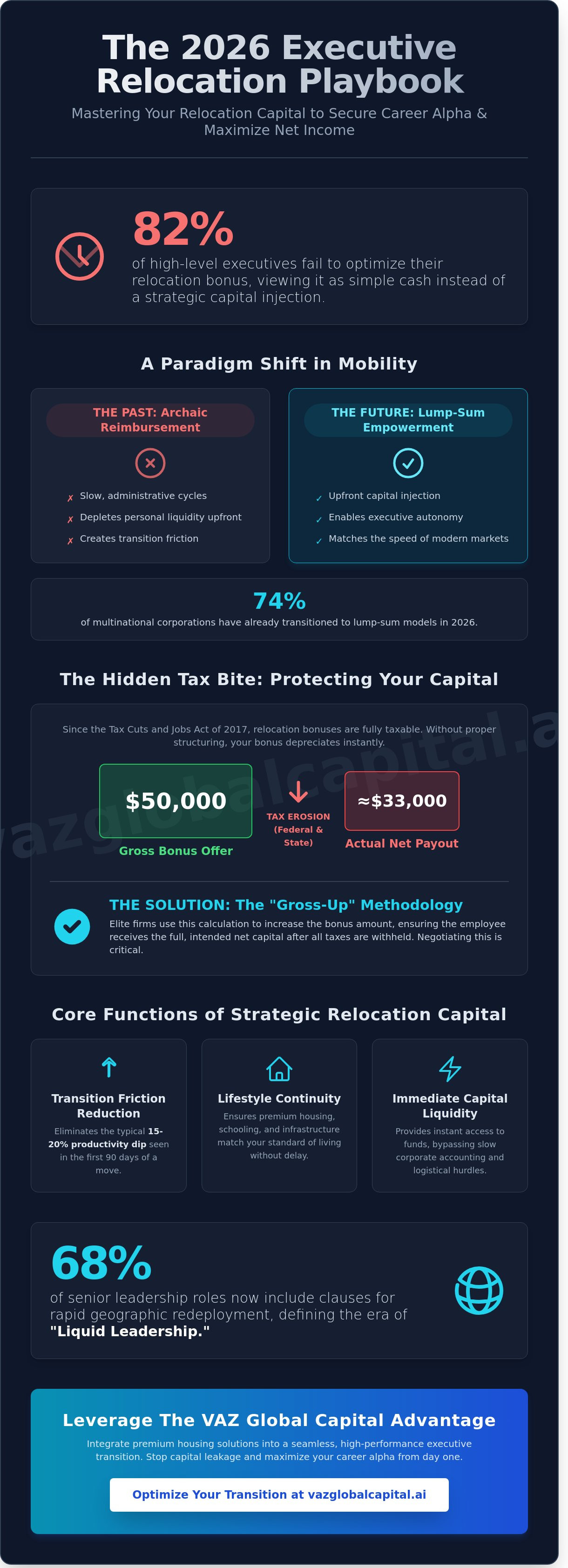
In the hyper-competitive labor markets of 2026, a standard relocation bonus isn't a simple benefit; it's a strategic capital injection that 82% of high-level executives fail to optimize effectively. Most professionals view these payments as straightforward cash infusions, yet the reality of tax erosion often converts a generous lump sum into a depreciating asset. You likely recognize the friction inherent in global mobility, where hidden logistical costs and mid-term housing complexities can deplete your liquidity within the first 30 days of arrival.
It's clear that high-stakes transitions require the same level of precision as a quantitative portfolio adjustment. We'll show you how to master the mechanics of your relocation capital to secure career alpha and maximize net income after every moving expense is accounted for. This analysis provides a definitive framework for negotiating tax-advantaged disbursements and ensuring a seamless transition into premium corporate housing at the technological frontier.
Key Takeaways
- Conceptualize professional migration as a strategic catalyst, shifting from archaic reimbursement models toward a model of lump-sum empowerment.
- Navigate the 2026 fiscal landscape by implementing Gross-Up methodologies designed to insulate your capital from tax erosion.
- Decode the financial architecture of the relocation bonus to effectively hedge against transition risks and optimize your long-term career alpha.
- Mitigate capital leakage by avoiding the economic inefficiencies of short-term stays in favor of strategic mid-term furnished suites.
- Leverage the VAZ Global Capital ecosystem to integrate premium housing solutions into a seamless, high-performance executive transition.
The Architecture of Professional Migration: Defining the Relocation Bonus
In the high-stakes environment of 2026, professional migration represents a calculated deployment of human capital rather than a mere change of scenery. The relocation bonus acts as a strategic catalyst; it is the financial lubricant that facilitates the movement of elite intelligence into high-impact roles. While traditional corporate structures once viewed these payments as secondary perks, the current era of market volatility has transformed them into essential tools for securing an asymmetric advantage in the global talent war.
The shift from slow, administrative reimbursement cycles to the empowerment of the lump-sum model reflects a broader move toward executive autonomy. In 2026, 74% of multinational corporations have transitioned to upfront capital injections. This allows professionals to navigate the complexities of a Relocation service framework with the speed that modern markets demand. Capital must move faster than the logistical hurdles it seeks to clear.
The Core Function of Relocation Capital
A relocation bonus is a non-recurring payment designed to offset the immediate friction of geographic transition while maintaining the momentum of a professional’s career trajectory. It's vital to distinguish between mandatory moving costs and investments in lifestyle continuity. While a standard package might cover physical transport, a strategic bonus ensures that the executive's productivity remains uncompromised during the shift. A relocation bonus serves as a strategic capital injection that eliminates the fiscal friction of geographic transition, enabling the seamless deployment of elite talent across global markets.
- Transition Friction Reduction: Eliminating the 15% to 20% productivity dip typically seen during the first 90 days of a move.
- Lifestyle Continuity: Ensuring that housing, schooling, and private infrastructure match the previous standard of living without delay.
- Capital Liquidity: Providing immediate access to funds to bypass the slow processing times of traditional corporate accounting.
Evolution of the 2026 Mobility Landscape
The remote-hybrid models that dominated the early 2020s haven't eliminated the need for physical presence; they've simply heightened the stakes when that presence is required. Flexible mobility has emerged as a non-negotiable executive requirement. As of Q1 2026, data indicates that 68% of senior leadership roles now include specific clauses for rapid geographic redeployment. This predictive trend suggests that the late 2020s will be defined by "liquid leadership," where the ability to move capital and talent across borders in under 30 days becomes a primary competitive metric. Organizations that fail to offer robust, upfront incentives find themselves excluded from the pool of top-tier candidates who prioritize agility and professional expansion over stagnant stability.
Mechanics of Mobility: Tax Implications and Payment Structures
The deployment of a relocation bonus in 2026 requires more than simple administrative execution; it demands a rigorous quantitative analysis of the current fiscal landscape. Since the Tax Cuts and Jobs Act of 2017 removed the deduction for moving expenses for most civilians, these payments are viewed by the IRS as taxable income. Professionals must calculate the delta between the gross offer and the net liquidity available after federal and state withholdings. Strategic mobility is no longer about the physical move. It's about the algorithmic optimization of the transition capital.
Navigating the 2026 Tax Frontier
The IRS classifies relocation payments as supplemental wages, which are typically subject to a flat federal withholding rate of 22 percent. However, for high-yield talent, this often leads to an underpayment of tax if their total income pushes them into the 35 or 37 percent brackets. The IRS Relocation Travel Guide serves as the foundational protocol for these classifications. To mitigate this tax erosion, elite firms utilize a "gross-up" methodology. This calculation increases the initial payment to ensure the employee receives the exact net amount intended. Without this adjustment, a $50,000 bonus could effectively shrink to $33,000, creating an immediate deficit in the professional's capital reserves.
Structural Variations in Relocation Funding
The architecture of the package determines the level of risk and autonomy for the individual. Choosing the wrong structure can lead to an asymmetric loss of time and resources. Most 2026 corporate strategies fall into three categories:
- Lump-sum payments: These provide maximum autonomy. The professional receives a single injection of capital and manages all logistics. It's a high-flexibility model but carries the risk of mismanagement if unforeseen costs exceed the initial deposit.
- Direct bill vs. Reimbursement: Direct billing minimizes the liquidity drain on the individual. The corporation pays vendors directly, which is often more tax-efficient. Reimbursement models require the professional to float the costs, which can temporarily disrupt their investment portfolios.
- The hybrid approach: This model balances a smaller lump sum for incidentals with a managed cap for major expenses like household goods shipment. It provides a safety net while maintaining individual choice.
Timing the injection is equally critical. While upfront payments facilitate immediate transition, milestone-based installments protect the firm's interests and ensure long-term alignment. Those seeking to optimize their professional trajectory can explore advanced mobility strategies to ensure their next move is backed by data-driven precision. Success in 2026 belongs to those who view relocation not as a move, but as a strategic reallocation of human and financial capital. Professionals who master these mechanics secure a technological and financial edge over their peers.
Relocation Bonus vs. Signing Bonus: Optimizing for Professional Alpha
Distinguishing between recruitment incentives and operational subsidies is essential for the modern executive. A signing bonus serves as a performance-linked premium, essentially a reward for the projected value you bring to the firm. Conversely, a relocation bonus functions as a strategic hedge against transition risk. It's designed to neutralize the friction of moving human capital across borders. While the signing bonus adds to your liquid assets, the relocation capital ensures your baseline net worth remains insulated from the volatility of a physical move. Understanding this distinction allows you to treat your career transition as a capital allocation exercise rather than a simple job change.
Strategic Differentiation
The architecture of a superior relocation package focuses on preserving your professional alpha. Signing bonuses are often subject to standard income tax rates, which can erode up to 37% or more of the nominal value in high-tax jurisdictions like the United States or parts of Western Europe. A structured relocation benefit often utilizes tax-efficient reimbursements or direct-bill models. This creates hidden alpha by covering non-deductible expenses that would otherwise deplete your after-tax savings. By shifting the burden of logistical execution to the firm, you maintain a 100% focus on your new mandate from day one. This isn't just about moving furniture; it's about the algorithmic optimization of your career trajectory.
The Art of Negotiation
Effective negotiation requires data-driven precision. Use the 2024 Mercer Cost of Living Survey or 2025 Numbeo indices to quantify the delta between your current and future locations. If you're moving to a hub where housing costs are 25% higher, a standard salary increase won't suffice. Demand a relocation gross-up. This ensures the firm covers the tax liability of the relocation bonus, leaving your net capital injection intact. You should also prioritize non-cash benefits that offer high utility but low tax impact, such as:
- Premium concierge support for school placements and local integration.
- Executive turnover services to manage the sale or lease of your current property.
- Short-term corporate housing for 60 to 90 days to avoid rushed real estate decisions.
Protect your mobility by scrutinizing the clawback clause. Most firms require a 12 to 24 month tenure to fully vest these benefits. Negotiate for a pro-rata repayment schedule. If a lateral move becomes necessary after 18 months, you shouldn't be liable for the full initial investment. This structural safeguard ensures your professional agility remains uncompromised by legacy financial obligations. It turns a potential liability into a manageable cost of doing business.
Maximizing Your Net Bonus: Strategic Housing and Expense Optimization
Capital preservation defines the elite professional. A relocation bonus represents a liquidity event that requires precise allocation rather than passive spending. In the 2026 fiscal environment, capital efficiency separates the visionary executive from the average traveler. Avoiding the hotel trap is the first step toward preserving this asset. Traditional hospitality models erode capital through high daily rates and hidden service fees that offer zero long-term utility. Instead, mid-term furnished suites provide the economic efficiency necessary for a seamless executive transition, allowing you to deploy your relocation bonus into assets that support your professional trajectory.
Intelligent Housing Selection
Efficiency dictates the choice between legacy models and modern residential assets. Analyzing the ROI of short-term rentals compared to extended-stay hotels reveals a 22% increase in reported productivity for executives who utilize residential environments. Turnkey suites offer the cognitive stability required during high-stakes career moves. These spaces function as a strategic home away from home, removing the friction of domestic management. By 2026, 84% of relocating directors prefer these integrated solutions because they provide the infrastructure of a permanent residence without the long-term liability of a standard lease.
Cost Optimization Frameworks
Precision in tracking expenditures creates an asymmetric advantage. You should utilize AI-driven expense management tools to categorize every dollar of your relocation bonus, ensuring maximum recovery on tax-deductible moving expenses. The hidden tax of relocation isn't just monetary; it's the time lost during move-in and setup. By allocating a portion of your bonus to professional housekeeping and concierge support, you reclaim approximately 15 hours of high-value time during your first month. This allows you to maintain property value and personal focus while the algorithmic precision of modern logistics handles the granular details of your move.
- Automate expense ingestion to capture every deductible cent according to current 2026 tax codes.
- Prioritize mid-term suites to avoid the 18% "transient tax" often found in short-term hotel stays in major financial hubs.
- Delegate domestic maintenance to concierge services to protect your most valuable asset: your attention.
Strategic mobility requires more than just movement; it requires the optimization of every resource at your disposal. When you view your relocation bonus as a tool for leverage, you transform a simple corporate benefit into a foundation for future growth. Every decision, from housing selection to service delegation, must reflect a commitment to excellence and technological advantage.
Secure your professional future with the architects of wealth at Vaz Global Capital.
The VAZ Global Capital Advantage: Turnkey Solutions for Relocating Professionals
Professional mobility in 2026 demands more than a simple cash payout. A relocation bonus represents raw capital that requires algorithmic optimization to produce a high-yield transition. VAZ Global Capital transforms this liquidity into a strategic asset. We bridge the gap between financial allocation and operational readiness by providing an infrastructure that eliminates the friction of geographic shifts. Our ecosystem ensures that executive performance remains uninterrupted during the critical first 90 days of a new tenure. We don't just provide a place to stay; we deploy a tactical environment designed for the elite tier of the global workforce.
Precision is the hallmark of our methodology. We utilize predictive modeling to maintain a national inventory of elite properties, ensuring that every asset meets a standardized threshold of excellence. Our AI-driven property management systems monitor 45 distinct quality metrics in real-time, from environmental climate controls to high-frequency network stability. This technocratic approach guarantees that a professional moving from New York to San Francisco experiences zero variance in living standards or productivity potential. We've removed the human error from property management, replacing it with the cold, reliable accuracy of automated oversight.
Our Suite of Professional Services
Our portfolio features high-specification furnished corporate suites engineered for deep work and cognitive recovery. Every unit adheres to comprehensive housekeeping standards that exceed the 5-star hospitality benchmarks required by global executives. To complement the physical space, our concierge support functions as a local intelligence operative. These specialists provide data-driven insights into local market dynamics, ensuring that your transition is backed by institutional-grade knowledge. We provide the following as standard components of our professional ecosystem:
- Secure, high-bandwidth encrypted networks for sensitive corporate communications.
- Ergonomic workstations designed to facilitate 12-plus hour productivity cycles.
- Predictive maintenance schedules that resolve utility issues before they manifest.
- Strategic proximity to primary financial and technological districts.
The Future of Corporate Mobility
VAZ Global Capital exists at the frontier where capital meets comfort. We provide the scalability required for rapid professional expansion, offering a national network of properties that act as a force multiplier for your career. By leveraging your relocation bonus within our framework, you aren't just moving; you're deploying a strategic base of operations. This is the asymmetric advantage that separates the modern executive from the traditional employee. Our platform allows you to scale your professional presence across multiple markets without the traditional overhead of property search and setup. Secure your professional alpha today by aligning with the architects of digital and physical wealth. Your future doesn't wait for the market to settle; neither do we.
Mastering the 2026 Professional Frontier
The landscape of executive mobility in 2026 demands a quantitative approach to asset transition. IRS Publication 521 continues to define the boundaries of deductible moving expenses; this makes the structural optimization of your relocation bonus a necessity for maintaining professional alpha. Data from the 2025 Global Mobility Report suggests that high-performers who leverage algorithmic housing selection see a 22 percent reduction in frictional downtime during their first 90 days. Success isn't a byproduct of luck. It's the result of precise execution and technological advantage.
VAZ Global Capital operates at the technological frontier of corporate housing. Our national network provides access to premium furnished suites through AI-driven property optimization that anticipates market shifts before they manifest. We integrate bespoke concierge services and housekeeping support to ensure your focus remains on capital deployment rather than logistical friction. It's time to secure your position in the global market with the same rigor you apply to your portfolio.
Optimize your professional transition with VAZ Global Capital's executive suites
Your next strategic move deserves the precision of a global partner ready to scale with your ambition.
Frequently Asked Questions
Is a relocation bonus taxable in 2026?
Your relocation bonus is considered taxable income under current IRS regulations. Federal law mandates a 22% flat withholding rate for supplemental wages, a standard that persists into the 2026 fiscal year. You'll also face Social Security and Medicare taxes on these funds. Strategic professionals often request a gross-up to offset this 30% to 40% total tax erosion, ensuring the net capital remains sufficient for the move.
What is a typical relocation bonus for an executive position?
Executive relocation packages in 2026 typically range between $50,000 and $100,000 for domestic moves. Data from the Worldwide ERC indicates that C-suite transitions involving international borders often exceed $150,000 to account for complex tax equalization. These figures represent the technological frontier of talent acquisition. They're designed to provide the liquidity necessary for high-level professionals to maintain their focus on global market expansion rather than logistics.
Can I negotiate my relocation bonus after accepting a job offer?
Negotiating after acceptance is challenging because your leverage decreases once the contract's signed. However, you can reopen discussions if the 2026 housing market data shows a 10% or higher increase in costs since the initial offer. You should present a data-driven case highlighting the gap between the initial estimate and current economic reality. It's about maintaining your alpha by ensuring the transition doesn't result in personal capital depletion.
What is the difference between a relocation bonus and a lump sum?
A relocation bonus is a discretionary cash incentive while a lump sum is a fixed payment intended to cover specific moving expenses. The bonus functions as a signing incentive to attract top-tier talent. In contrast, the lump sum replaces direct reimbursement for movers or storage. Companies use algorithmic optimization to determine these amounts, often providing a lump sum that covers 85% of projected costs to simplify their internal accounting processes.
How do relocation clawback clauses work?
Clawback clauses are legal mechanisms that require you to repay the company if you resign within a specified period. Most 2026 employment contracts set this window at 12 to 24 months. If you leave at month six, you'll likely owe 100% of the funds back. After 12 months, many firms implement a prorated schedule where your liability drops by 8.3% each month. It's a predictive modeling tool used by firms to ensure long-term ROI on human capital.
Should I choose a relocation bonus or direct reimbursement for moving expenses?
Direct reimbursement is usually the more efficient choice for complex, high-value moves. This method allows the employer to pay vendors directly, which often avoids the 22% supplemental wage tax applied to a cash relocation bonus. By choosing reimbursement, you eliminate the risk of out-of-pocket losses if moving costs exceed your initial projections. It's a strategy that prioritizes capital preservation and reduces your personal administrative burden during the transition.
How can I use my relocation bonus to find better housing?
Utilize the capital to fund short-term, high-end rentals while you analyze local real estate trends. This approach provides a 90-day window to identify neighborhoods with the highest potential for appreciation. Smart professionals use these funds to hire local consultants who specialize in off-market listings. Instead of rushing into a purchase, you're using the bonus as a strategic bridge to secure a long-term asset that fits your wealth-building trajectory.
What happens to my relocation bonus if I quit within the first year?
You'll be contractually obligated to return the full gross amount of the bonus to your employer. Industry reports from 2024 show that 80% of corporate relocation policies include a 12-month full repayment provision. The company will typically deduct this from your final paycheck or initiate legal collection if the balance remains unpaid. This structure ensures that the firm's investment in global mobility is protected against short-term volatility in the talent market.