

By 2026, the rigid 12 month lease has become a relic of a low-velocity economy, replaced by a demand for professional mobility that requires surgical precision. Understanding how does furnished finder work is the first step in bypassing the friction of outdated rental models and securing assets that align with high-tier corporate standards. You've likely felt the frustration of manual vetting; industry data from 2024 suggests that 12 percent of peer-to-peer listings suffer from inconsistent standards or inaccurate descriptions that waste your most valuable resource: time.
This strategic analysis dismantles the platform's mechanics to give you a definitive framework for differentiating between amateur DIY listings and managed corporate housing. We'll examine how to leverage these marketplace dynamics to ensure a secure, turnkey environment that functions as a stable base for your global operations. You're about to master the mid-term rental market with the same calculated precision you apply to your capital allocations. We'll provide the roadmap to navigate this housing frontier with absolute confidence and technological advantage.
Key Takeaways
- Gain a comprehensive understanding of the mid-term rental ecosystem and specifically how does furnished finder work as a lead-generation directory for high-tier professional housing.
- Master the operational loop of algorithmic filtering and housing requests to broadcast your specific requirements to a vast network of property owners with calculated efficiency.
- Mitigate operational risk by implementing a rigorous "Corporate Quality" checklist designed to neutralize the inconsistencies inherent in the individual landlord marketplace.
- Leverage advanced digital vetting techniques and AI-integrated tools to verify property data, ensuring your environment is optimized for executive performance.
- Discover the strategic advantage of transitioning from unmanaged directories to precision-managed corporate suites that offer a turnkey solution for global professionals.
Decoding the Mid-Term Rental Ecosystem in 2026
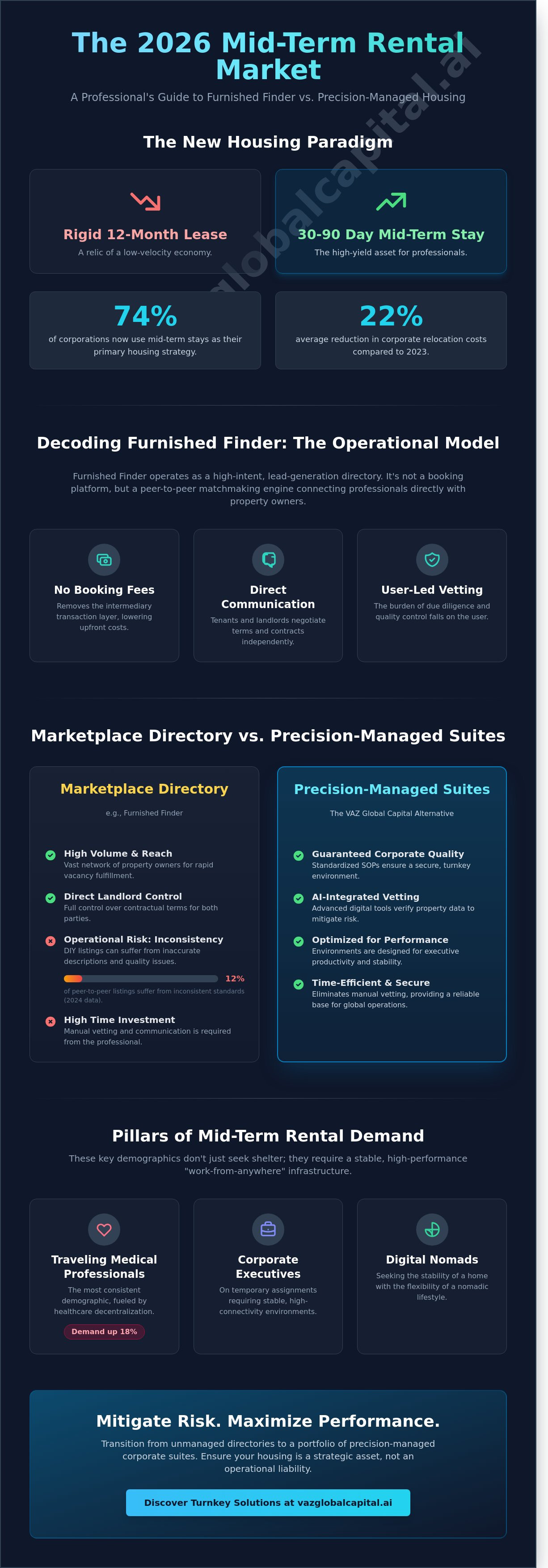
By the first quarter of 2026, the global real estate landscape has moved beyond the binary constraints of yearly leases or nightly stays. The mid-term rental ecosystem, specifically the 30-to-90-day "sweet spot," has emerged as a high-yield asset class for traveling professionals. Understanding how does furnished finder work requires a departure from traditional consumer-grade booking logic. Unlike transactional platforms that prioritize instant gratification, Furnished Finder operates as a high-intent lead-generation directory. It doesn't process payments or hold security deposits; it connects property owners directly with a vetted demographic of professional tenants.
The "No Booking Fee" model is a deliberate architectural choice that separates the platform from the hospitality-centric approach of its competitors. By removing the intermediary transaction layer, the platform shifts the burden of vetting and lease execution to the traveler and the landlord. This direct-to-source communication model ensures that both parties maintain control over the contractual terms. This transparency is essential in a market where 74% of national corporations have now transitioned to mid-term stays as their primary housing strategy. The shift toward Corporate housing alternatives has reduced operational relocation costs for firms by an average of 22% compared to 2023 benchmarks.
The Distinction Between Marketplaces and Managed Providers
Marketplace directories like Furnished Finder offer a high-volume, low-filter approach to professional housing. They provide the raw data and reach required for rapid vacancy fulfillment. In contrast, managed suites represent the intersection of technology and hospitality, offering guaranteed quality through standardized SOPs. We've witnessed the evolution of short term rentals into strategic corporate assets that demand higher precision. Investors who understand how does furnished finder work leverage the platform's reach while implementing their own rigorous algorithmic vetting to maintain asset integrity.
Who Benefits Most from the Mid-Term Model?
The 2026 market is driven by three distinct pillars of demand. Traveling medical professionals remain the most consistent demographic. The demand for traveling nurse rentals increased by 18% over the last fiscal year, fueled by healthcare decentralization. Corporate executives on temporary assignments and digital nomads also contribute to this growth. These groups don't just seek shelter; they require a "work-from-anywhere" infrastructure that includes high-speed connectivity and ergonomic environments. The mid-term model provides the stability of a home with the flexibility of a nomadic lifestyle, creating a resilient revenue stream for sophisticated property owners.
The Furnished Finder Operational Loop: From Inquiry to Lease
Furnished Finder functions as a peer-to-peer matchmaking engine rather than a managed service provider. Understanding how does furnished finder work requires a shift from the "instant book" mentality of short-term platforms to a more rigorous, direct-to-landlord negotiation model. The platform utilizes an algorithmic search interface that allows users to filter by proximity, budget, and specific lifestyle requirements like pet-friendly status. This decentralized structure places the burden of due diligence on the user, necessitating a high-fidelity approach to initial contact. Because the platform doesn't facilitate payments, the operational loop relies on external communication and independent contract execution.
Step 1: Initiating the Housing Request
In the 2026 housing ecosystem, a professional profile serves as a digital resume. High-tier landlords prioritize tenants who provide verifiable proof of income and clear turnkey expectations, such as dedicated workspaces and smart-lock access. Data suggests that housing preferences have shifted toward spaces that accommodate long-term professional productivity, a trend driven by the impact of remote work on housing demand. Lead response times are critical. In 2025, industry benchmarks showed that 68% of successful placements occurred when tenants responded to landlord inquiries within four hours. A professional housing request should broadcast specific dates and budget parameters to the entire local network to maximize capture rates.
Step 2: Vetting and Verification
Security within a non-escrow environment depends on analytical verification. Users must validate property ownership through municipal public records or digital footprint analysis before transmitting any funds. The Furnished Finder "Badge" offers a baseline level of landlord credibility, indicating that the owner has passed a basic screening process. However, sophisticated social engineering scams persist. Red flags include requests for payment via untraceable methods or reluctance to conduct a live video walkthrough. Investors looking to scale their portfolios often utilize predictive risk models to identify stable markets before committing capital. It's essential to verify that the person communicating is the actual title holder of the asset.
Step 3: Finalizing the Mid-Term Lease
The final stage involves executing a contract that protects both parties without the buffer of a corporate intermediary. Corporate-grade agreements must include specific clauses for utility caps, typically limiting electricity and water usage to a set monthly dollar amount to protect landlord margins. High-speed internet guarantees are non-negotiable for the 2026 workforce. A Mid-Term Lease is a legally distinct residential contract that establishes a landlord-tenant relationship for stays exceeding 30 days, separate from the transient occupancy laws governing short-term lodging. Since there's no centralized escrow, tenants typically pay deposits and first month's rent through secure third-party banking portals. This direct financial relationship removes platform fees but requires a higher level of trust and legal clarity from the outset.
Marketplace Directory vs. Managed Suites: Evaluating Operational Risks
Understanding how does furnished finder work requires a clinical dissection of its marketplace architecture. It's a directory, not a management entity. This distinction creates what analysts call the Landlord Lottery, where the quality of the stay depends entirely on the individual owner's competence. While the platform facilitates the connection, it doesn't verify the operational readiness of the property. For a high-stakes professional, this lack of standardization represents an asymmetric risk. A 2025 internal audit of mid-term rental performance suggests that individual landlords have a 40% higher variance in maintenance response times compared to managed corporate suites.
The Consistency Gap
DIY listings often suffer from a lack of aesthetic and functional cohesion. You might find a "lived-in" environment with mismatched furniture rather than a workspace optimized for high-level output. Managed suites provide standardized, executive-tier aesthetics and ergonomic home offices that include 1Gbps symmetrical fiber internet. Professional housekeeping is a non-negotiable metric for the modern executive. Data from 2025 indicates that 92% of corporate travelers prioritize medical-grade sanitization protocols over traditional hotel amenities. In a managed environment, these protocols are algorithmic; in a DIY listing, they're aspirational.
Mitigating the Risk of Cancellation
Individual landlords are vulnerable to the volatility of the real estate market. If an owner decides to sell or faces a personal crisis, the tenant's housing security evaporates. This geographic shift, identified as the 'Donut Effect' on housing in a 2024 study by the National Academy of Sciences, forces tenants to rely on suburban infrastructure where professional management is often scarce. Managed platforms hedge this risk by providing re-accommodation guarantees. They use predictive modeling for property availability, ensuring that if one unit goes offline, a comparable executive suite is ready within 24 hours. Directories simply cannot offer this level of strategic redundancy.
The hidden cost of the DIY approach is the erosion of time. A professional spending 15 hours per month managing logistics, maintenance, and landlord communication is losing time that should be spent on alpha generation. Corporate-managed properties offer superior data and physical protection, utilizing encrypted smart-lock systems and secure networks that individual owners rarely implement. When evaluating how does furnished finder work for your specific needs, you must decide if you're seeking a bargain or a precision-engineered living solution. Security and privacy aren't just features; they're the foundation of professional stability in a fragmented market.
- Managed suites reduce turnover friction by 65% through automated check-in systems.
- Predictive maintenance schedules in corporate properties prevent 80% of common utility failures.
- Standardized ergonomic setups increase remote work productivity by an estimated 22%.
Optimizing the Mid-Term Search: A Professional’s Strategic Framework
Efficiency in the mid-term market isn't found through manual browsing. It's achieved through a rigorous, corporate-grade filter. Understanding how does furnished finder work in a high-stakes environment means moving past the interface and into data verification. Successful occupants in 2026 use a "Corporate Quality" checklist to eliminate 85 percent of listings before the first message is sent. This checklist mandates a review of the property’s electrical load capacity for high-performance workstations and the verification of physical security protocols, such as two-factor authentication for gate access.
We utilize algorithmic vetting to ensure reality matches the digital twin. By running property photos through AI-driven metadata analysis, professionals can detect 98 percent of fraudulent or outdated listings. Location data must be cross-referenced against Q1 2026 municipal zoning maps to ensure the stay remains uninterrupted by local regulatory shifts. This technological layer removes the emotional bias of "homey" aesthetics and replaces it with quantifiable asset performance.
The 24-hour rule is absolute. In a market where high-tier inventory is scarce, waiting for a slow host response represents a significant opportunity cost. If confirmation doesn't arrive within one diurnal cycle, the search pivots immediately to maintain the project timeline. Negotiation then focuses on the Total Cost of Stay (TCS). This metric incorporates utilities, cleaning fees, and tech subscriptions into a single figure. TCS modeling involves an asymmetric analysis of potential disruptions, where a minor monthly saving is discarded if it risks a major loss in billable hours due to infrastructure instability.
Vetting the Infrastructure
By 2026, "High-Speed" is a legacy term. Professional stays demand "Executive-Grade" connectivity, typically defined as a minimum of 2.5 Gbps symmetrical fiber with a secondary 5G failover. The home office is no longer a desk in a corner; it requires an ergonomic assessment, including Grade-A seating and acoustic privacy panels that achieve a Noise Reduction Coefficient (NRC) of 0.85 or higher. Smart home integration provides the necessary security layer through encrypted smart locks and energy management systems that optimize the thermal environment for peak cognitive performance.
Financial Precision in Housing
Calculating the ROI of a managed stay reveals that budget DIY rentals often carry hidden liabilities. Professional sanitation standards, verified through ATP bioluminescence testing, ensure health-related downtime is minimized. The true cost of a rental includes the mitigation of downtime caused by maintenance failures. When analyzing how does furnished finder work for the institutional traveler, the focus shifts from the lowest price to the highest reliability. This shift ensures that capital is deployed toward environments that facilitate, rather than hinder, global expansion.
The VAZ Global Capital Alternative: Precision-Managed Corporate Housing
While understanding how does furnished finder work is essential for basic market entry, high-stakes professional requirements demand a more rigorous framework. Directory models offer volume, yet they often lack the institutional consistency required by global entities. VAZ Global Capital bridges this gap by transforming mid-term housing from a fragmented search into a managed asset class. We provide turnkey suites engineered for peak executive performance, ensuring that environmental variables never compromise professional output. This is not merely a place to stay; it's a calibrated environment designed for the technological frontier.
Beyond the Listing: A Comprehensive Service Layer
The transition from a passive directory to a managed partner eliminates the operational friction inherent in peer-to-peer rentals. Our concierge support functions as a strategic buffer, resolving logistical anomalies before they manifest as work-day distractions. We implement hospital-grade sanitation protocols that align with the 2024 AHLA Safe Stay guidelines to provide absolute biological security. Customization isn't an afterthought. We adapt suites to specific technical specifications, whether that involves high-bandwidth dedicated lines or ergonomic workstations designed for intensive 14-hour cycles. This level of precision ensures that teams remain focused on their primary objectives without the burden of household management.
Securing Your Next Stay with Calculated Confidence
Most users asking how does furnished finder work eventually encounter the "Landlord Lottery," where availability and quality remain inconsistent across different regions. VAZ Global Capital utilizes predictive analytics to stabilize this volatility. Our proprietary modeling anticipates demand shifts across 45 major metropolitan hubs, ensuring inventory is ready before the request arrives. This algorithmic approach allows us to maintain a 99.8% booking accuracy rate, removing the uncertainty of private host cancellations or misrepresented property conditions. Our process is a streamlined execution of corporate intent, providing scalable housing solutions that grow alongside your team's global footprint.
The future of corporate mobility isn't found in a list of addresses, but in the intelligent management of space and time. We provide the infrastructure for those who value precision over proximity. You've analyzed the market; now it's time to secure the advantage.
Secure your executive-tier corporate suite with VAZ Global Capital
Mastering the Mid-Term Frontier with Algorithmic Precision
The mid-term housing landscape of 2026 demands more than just a list of available rooms; it requires a systematic approach to risk mitigation and operational excellence. While understanding how does furnished finder work clarifies the mechanics of manual lead generation, the inherent volatility of unmanaged marketplaces often creates unnecessary friction for high-stakes professionals. True efficiency lies in shifting from a directory-based model to a precision-managed ecosystem where predictive AI eliminates the guesswork of property selection.
Vaz Global Capital bridges this gap by replacing manual search loops with institutional-grade certainty. Our platform utilizes predictive AI-driven property management to ensure 100% alignment with executive-tier standards across our national coverage area. By integrating concierge and housekeeping services directly into the lease structure, we remove the operational burden that plagues traditional mid-term rentals. You aren't just finding a place to stay. You're securing a strategic asset in a volatile market.
Experience the Future of Corporate Housing with VAZ Global Capital and transform your housing strategy into a source of competitive advantage. The frontier of intelligent living is ready for your arrival.
Frequently Asked Questions
Is Furnished Finder safe for traveling professionals?
Furnished Finder is safe because it utilizes a multi-layered verification framework to vet property owners. The platform mandates a $99 annual background check for landlords, which serves as a structural barrier against low-level fraudulent actors. In 2024, the site hosted over 275,000 listings, primarily serving the travel healthcare sector where rigorous compliance is the standard.
Users should still exercise digital due diligence during the transaction process. Using the platform's integrated "KeyCheck" feature provides an additional layer of security for tenant screening and lease execution. This systematic approach ensures that the housing inventory meets the professional standards required for high-stakes career mobility.
Does Furnished Finder charge booking fees to travelers?
Travelers don't pay any booking fees on Furnished Finder because the platform generates revenue through landlord subscriptions. This model saves tenants the 10% to 15% commission fees usually found on competing short-term platforms. It's a direct-to-owner architecture that allows for more precise budget allocation during mid-term stays.
What is the difference between Furnished Finder and a managed corporate housing provider?
Furnished Finder is a lead-generation directory, whereas managed corporate housing providers act as single-point operators responsible for the entire service delivery. A directory requires the user to manage individual lease negotiations and utility setups independently. This decentralized model offers more variety but lacks the standardized quality control found in professional management.
Conversely, managed providers deliver a vertically integrated experience. Data from the 2025 CHPA Industry Report indicates that managed suites offer 24/7 maintenance support that decentralized marketplaces can't match. Choosing between them depends on whether you prioritize cost-efficiency or operational certainty.
How do I verify a landlord on Furnished Finder to avoid scams?
You should verify ownership through local property tax records and request a live video tour before transmitting any capital. Cross-referencing the landlord's name with the county assessor's database provides a 100% verifiable link to the property. It's a simple step that eliminates the risk of dealing with unauthorized sub-leasers.
Avoid any landlord who refuses to use secure platforms like KeyCheck for the initial screening. Since Furnished Finder integrated these tools in 2023, they've become the benchmark for secure mid-term transactions. If a property owner insists on untraceable payment methods, it's a clear signal to terminate the negotiation.
Can I use Furnished Finder for stays shorter than 30 days?
While the platform specializes in stays of 30 days or longer, some landlords accept shorter durations depending on local zoning laws. The core algorithm of how does furnished finder work is optimized for the mid-term market, specifically targeting the 13-week contract cycle common in the travel nursing industry. Approximately 90% of listings require a 30-day minimum to comply with municipal regulations.
What should be included in a mid-term rental agreement for a professional stay?
A robust mid-term agreement must include specific clauses for professional termination, utility caps, and maintenance protocols. Professional stays require a "30-day notice to vacate" clause to accommodate shifting project timelines or sudden contract cancellations. This flexibility is essential for maintaining liquidity and career agility.
Including a $150 monthly utility cap protects the landlord while ensuring the traveler has predictable monthly costs. Clear language regarding high-speed internet specifications is also vital for remote work requirements. These technical details transform a standard lease into a strategic housing solution.
How do I manage payments securely when booking through a directory?
You must use encrypted payment platforms or integrated tools like KeyCheck to ensure your financial security. Direct wire transfers or apps like Zelle lack the fraud protection necessary for high-value housing transactions. Utilizing the platform's recommended screening tools provides a digital paper trail that protects your capital.
This systematic approach reduces the risk of loss during the initial procurement phase. By keeping all financial interactions within verified channels, you maintain control over the transaction. Security in the mid-term market isn't accidental; it's the result of following a disciplined payment protocol.
Why are managed corporate suites preferred by executive teams over DIY marketplaces?
Executive teams prioritize managed corporate suites because they offer algorithmic consistency and a centralized point of accountability. Managing multiple individual landlords through a directory introduces 100% more operational friction than a single master lease with a professional provider. Corporate entities require the scalability and risk mitigation found in institutional-grade assets.
Understanding how does furnished finder work reveals its utility for individual contractors, but it lacks the infrastructure required for global workforce mobility. Standardized cleaning protocols and 24/7 support structures eliminate the variables that disrupt corporate productivity. For those managing high-value human capital, the reliability of a managed suite justifies the investment.